IoT adoption is often misunderstood as a single deployment step — install devices, connect them to the cloud, and visualize data. In reality, organizations that succeed with IoT move through distinct maturity stages, each unlocking greater operational intelligence and business value.
True IoT maturity isn’t about technology alone. It’s about how effectively an organization transforms data into decisions, automation, and optimization.
This article outlines a practical IoT maturity model that organizations follow as they evolve from early experimentation to autonomous, AI-driven systems.
Why IoT Maturity Matters
Many IoT initiatives stall after pilots because they lack a roadmap. Without a maturity framework, teams:
- Collect data without clear outcomes
- Struggle to scale deployments
- Fail to translate insights into action
- Miss long-term ROI
Understanding IoT maturity helps organizations align strategy, architecture, and operations as systems grow.
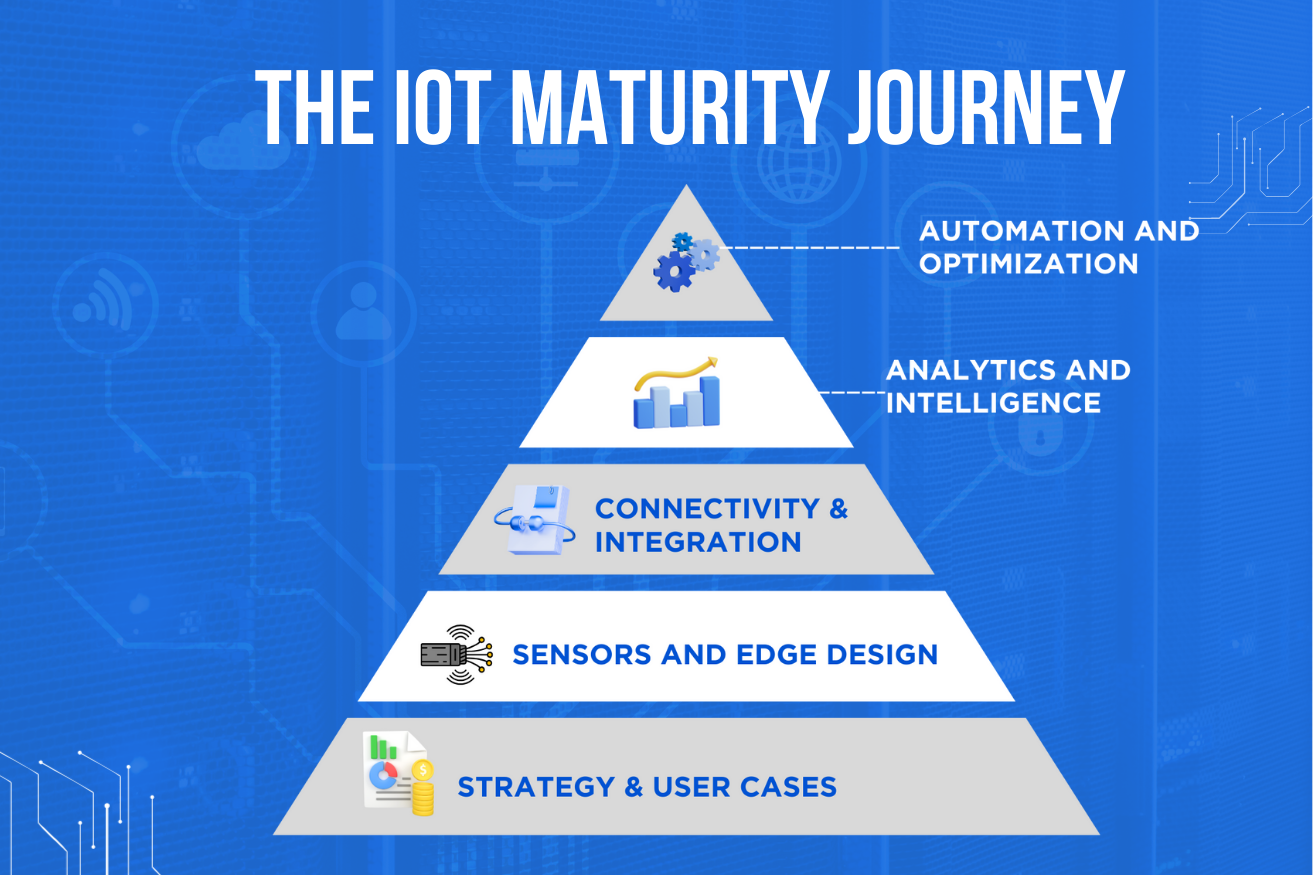
Level 1 — Strategy and Use Case Definition
Every successful IoT initiative starts with why.
At this stage, organizations:
- Identify specific business problems
- Define measurable outcomes and ROI
- Determine where IoT adds real operational value
The goal is not connectivity, but impact. Without clear use cases, even technically sound systems fail to justify investment.
Level 2 — Sensor Selection and Edge System Design
Once the strategy is clear, attention shifts to the physical layer.
This stage focuses on:
- Selecting reliable, environment-appropriate sensors
- Designing edge devices for performance, latency, and power
- Ensuring resilience against noise, temperature, and field conditions
Strong edge design creates the foundation for scalability. Poor decisions here propagate failures throughout the system lifecycle.
Level 3 — Connectivity and Data Ingestion
As deployments grow, reliable data flow becomes critical.
At this stage, organizations:
- Establish secure communication pipelines
- Choose protocols aligned with scale and reliability
- Design gateways and ingestion services for high-frequency data
Connectivity is often underestimated, but it determines whether systems remain reliable as device counts increase.
Level 4 — Data Processing and Analytics
Collecting data alone does not create value. This stage is where intelligence begins to emerge.
Key activities include:
- Cleaning and structuring raw telemetry
- Building analytics pipelines and dashboards
- Applying AI tools for trend detection and anomaly analysis
This layer transforms signals into actionable insight, enabling informed operational decisions.
Level 5 — Automation, Optimization, and Scaling
The highest level of IoT maturity is autonomy.
At this stage, systems:
- Trigger actions automatically based on insights
- Optimize operations continuously
- Enable predictive maintenance and self-healing workflows
- Scale across sites, regions, or fleets
Human oversight remains important, but systems increasingly handle decisions independently — improving efficiency and reducing response time.
Common Pitfalls on the IoT Maturity Journey
Organizations often encounter challenges when:
- They skip strategic definition and start with hardware
- Edge design is rushed without field validation
- Connectivity is treated as a secondary concern
- Analytics are added without clean data foundations
- Automation is attempted without observability
Recognizing maturity gaps early prevents costly rework later.
IoT Maturity Is About Operational Intelligence
IoT maturity is not about deploying the latest technology. It’s about evolving operations to become:
- More responsive
- More predictive
- More autonomous
Organizations that treat IoT as a long-term capability — not a one-time project — unlock sustained competitive advantage.
How MetaDesk Global Supports IoT Maturity
At MetaDesk Global, we help organizations progress through each stage of IoT maturity — from early strategy to fully automated systems.
Our approach emphasizes:
- Business-driven architecture
- Robust edge and connectivity design
- Scalable data and AI pipelines
- Automation aligned with real operational needs
By designing systems with maturity in mind, we help teams build IoT platforms that grow with their business.
Final Thoughts
IoT success doesn’t happen overnight.
It’s a journey from:
Connected data → Intelligent insight → Autonomous action
Organizations that understand and plan for this progression are far better positioned to realize the full value of IoT.