




Logo home 9

Over 10 years we helping companies reach their financial and branding goals. Onum is a values-driven SEO agency dedicated.

CONTACTS
Embedded IoT Solutions

IoT in Manufacturing: Where It Pays and What Makes It Hard

Category
Embedded IoT Solutions
Read Time
7 min read
Published
October 21, 2025
Status
Published

A production line has countable outcomes, so a connected system either moves them or it does not. That clarity makes value easy to prove and failure impossible to hide.

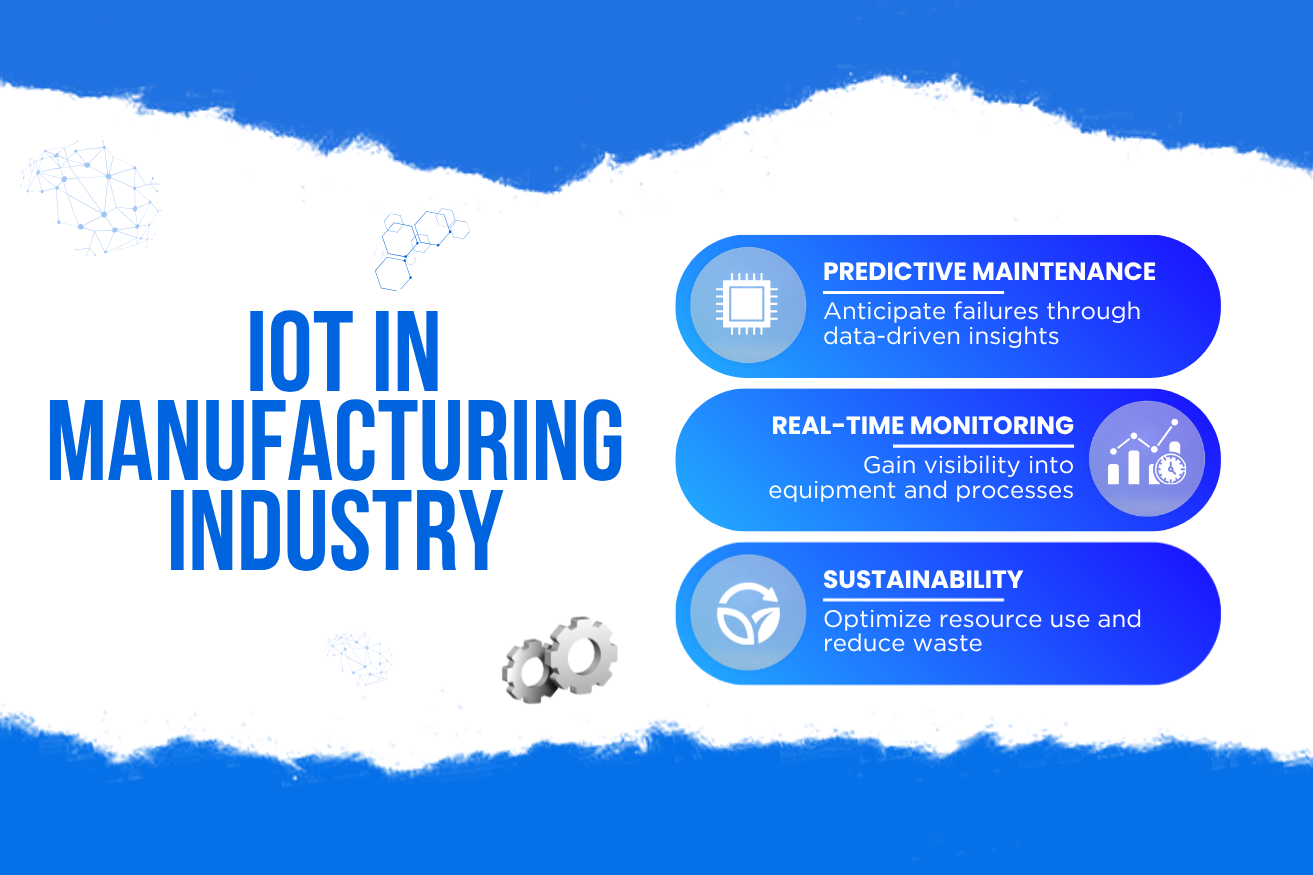
Manufacturing was IoT’s first serious market and remains its most measurable one. A production line already has countable outcomes — units per hour, scrap rate, unplanned downtime — so a connected system either moves those numbers or it does not.

That clarity cuts both ways. It makes value easy to prove, and it makes failure impossible to hide behind an impressive dashboard.

This guide covers where IoT genuinely pays in manufacturing, what makes factory deployments harder than they look, and how to structure a programme that survives past the first line.

Applications

Where IoT Pays in a Factory

1

Unplanned downtime reduction

The highest-value application almost everywhere. Vibration, current, and temperature monitoring on motors, pumps, gearboxes and compressors detects degradation early enough to schedule repair rather than react to failure.

The economics are straightforward: an hour of stopped production has a known cost, so avoiding a handful of stoppages per year usually pays for the instrumentation. The approach is covered in depth in predictive maintenance for IoT.

2

Real OEE instead of estimated OEE

Most plants calculate overall equipment effectiveness from manual logs, which smooth over short stops and misattribute causes. Machine-level data produces an honest number and, more usefully, an honest breakdown of where the time actually went.

Short stops are frequently the biggest hidden loss: individually trivial, collectively larger than the breakdowns everyone discusses.

3

Quality inspection at line speed

Vision systems check surface defects, presence and absence, labels, and dimensions on every unit rather than on samples — consistently, without inspector fatigue, and with a record attached to each item.

The practical constraints are optical rather than algorithmic, as covered in embedded computer vision: lighting and lens choice decide accuracy far more than model architecture.

4

Energy and utilities monitoring

Sub-metering by line, machine, or process reveals where energy actually goes, which is frequently not where the plant assumes. It also exposes equipment running outside its efficient operating point and idle load that nobody has ever measured.

5

Traceability and compliance

Automatically linking process conditions to each batch or serial number turns audits and recalls from a manual reconstruction into a query. In regulated sectors this is often the business case on its own.

6

Materials and asset tracking

Knowing where tooling, fixtures, WIP and containers are removes a surprising amount of daily searching, and makes inventory counts reflect reality rather than records.

Constraints

Why Factories Are Harder Than They Look

Equipment predates the internet
A plant floor holds decades of machines speaking Modbus, Profinet, EtherNet/IP, OPC UA, or proprietary serial protocols — and some speaking nothing at all, requiring external sensors instead of integration.
The OT boundary is real
Control networks are separated from IT because a delayed packet can damage equipment or injure someone. Data paths must be read-only and outbound-only, and security review is a gate rather than a formality.
The environment is hostile
Temperature extremes, vibration, dust, coolant, wash-down, and electrical noise from drives and welders are normal operating conditions, not edge cases.
Downtime for installation is scarce
Instrumenting a machine often means waiting for a planned shutdown, which shapes rollout schedules more than engineering effort does.
Operators decide whether it survives
A system that produces alerts the floor does not trust gets ignored within weeks. Precision matters more than recall: a few reliable alerts beat many speculative ones.
Architecture

What a Working Factory Deployment Looks Like

LayerTypical choiceWhy
SensingRetrofit vibration, current and temperature sensors; existing PLC tags where availableAvoids modifying certified machine control
Edge gatewayIndustrial gateway doing protocol translation and bufferingAbsorbs equipment differences; keeps working if the uplink fails
Local processingFiltering, feature extraction, line-level reactionHigh-rate vibration data is impractical to send raw
ConnectivityWired where possible; outbound-only to the platformPredictable, and clears security review
PlatformTime-series storage, cross-asset comparison, model trainingNeeds history and fleet-wide context
ActionWork orders into the existing CMMSInsight only counts when it reaches a maintenance queue

The consistent pattern is that heterogeneity is absorbed at the edge so everything above sees one normalised shape. That decision is what makes the second and third site affordable, as covered in scaling industrial IoT across sites.

Execution

Running the Programme So It Scales

1Start with one measurable loss
Pick a specific failure mode on a specific line with a known cost. A narrow win produces a number the plant manager recognises; a broad pilot produces a dashboard nobody owns.
2Instrument the baseline before changing anything
Without a measured starting point, any improvement will be argued about. Collect several weeks of normal operation first.
3Bring OT and security in during design
Read-only, outbound-only connections with certificate-based device identity resolve most objections. A review at the end is a gate that can stop the programme.
4Route alerts into the maintenance system
An alert that lands only in a dashboard changes nothing. It must become a work order with an owner and a recorded outcome.
5Record whether each alert was right
This is the only ground truth you will have, and it is what lets precision improve instead of trust eroding.
6Give maintenance an operational owner
Programmes owned only by engineering or innovation teams lose funding once the pilot succeeds. Operations must accept the KPI and the support load.
FAQ

Frequently Asked Questions

How is IoT used in manufacturing?
Mainly for predictive maintenance to cut unplanned downtime, accurate OEE measurement, vision-based quality inspection at line speed, energy sub-metering, batch traceability for compliance, and tracking tooling, WIP and containers.
What is the highest-value IoT application in a factory?
Usually reducing unplanned downtime. An hour of stopped production has a known cost, so detecting bearing, motor, or pump degradation early enough to schedule repair typically pays for the instrumentation within a handful of avoided stoppages.
How do you connect old machines that have no network interface?
Two routes: read existing controller tags over Modbus, OPC UA, Profinet or EtherNet/IP where a PLC exists, or retrofit external sensors for vibration, current and temperature where it does not. Both terminate at an edge gateway that normalises the data.
Why does IT and OT separation matter for factory IoT?
Control networks carry traffic where delay or interference can damage equipment or endanger people. Monitoring systems must therefore be read-only and outbound-only, with no inbound ports into the plant network, and must align with the site’s existing segmentation model.
Why do manufacturing IoT pilots fail to scale?
Commonly because the first site was built as a one-off, so every later plant is a fresh integration project; because alerts never reached the maintenance system; or because operators stopped trusting a system that produced too many speculative alerts.
How do you prove ROI on factory IoT?
Choose one failure mode with a known cost, measure a baseline over several weeks before changing anything, route alerts into the CMMS as work orders, and record the outcome of every alert. That produces a number in units the plant already reports.
Wrapping Up

Conclusion

Manufacturing suits IoT because the outcomes are already counted. Downtime, scrap, energy and throughput are numbers the plant reports anyway, so a connected system can be judged honestly.

The engineering challenges — legacy protocols, the OT boundary, a hostile environment, scarce installation windows — are well understood and solvable. The programme risks are organisational: starting too broad, leaving alerts in a dashboard, and having no operational owner. Handle those and the technology rarely becomes the limiting factor.

About MetaDesk Global

Engineering the Next Generation of Connected Products

MetaDesk Global helps startups and enterprises develop intelligent connected products that combine embedded systems, Industrial IoT, Edge AI, and cloud technologies. Our expertise includes:

Industrial IoT (IIoT) Solutions Embedded Firmware Development Edge AI Development Predictive Maintenance Systems PCB Design IoT Gateway Development Cloud Integration OTA Firmware Updates AIoT Product Development End-to-End Product Engineering

From hardware design to AI-powered industrial platforms, we build scalable solutions for the next generation of connected products.

Start Your Project

Building a Connected Product?

We design IIoT sensor networks, Edge AI pipelines, and secure cloud platforms — from prototype to production.

Request a Free Quote →