The term AIoT is often used loosely to describe any IoT system with a machine-learning model
attached. In reality, the difference between IoT and AIoT is far deeper — and treating them as
the same is one of the most common reasons intelligent products fail in production.
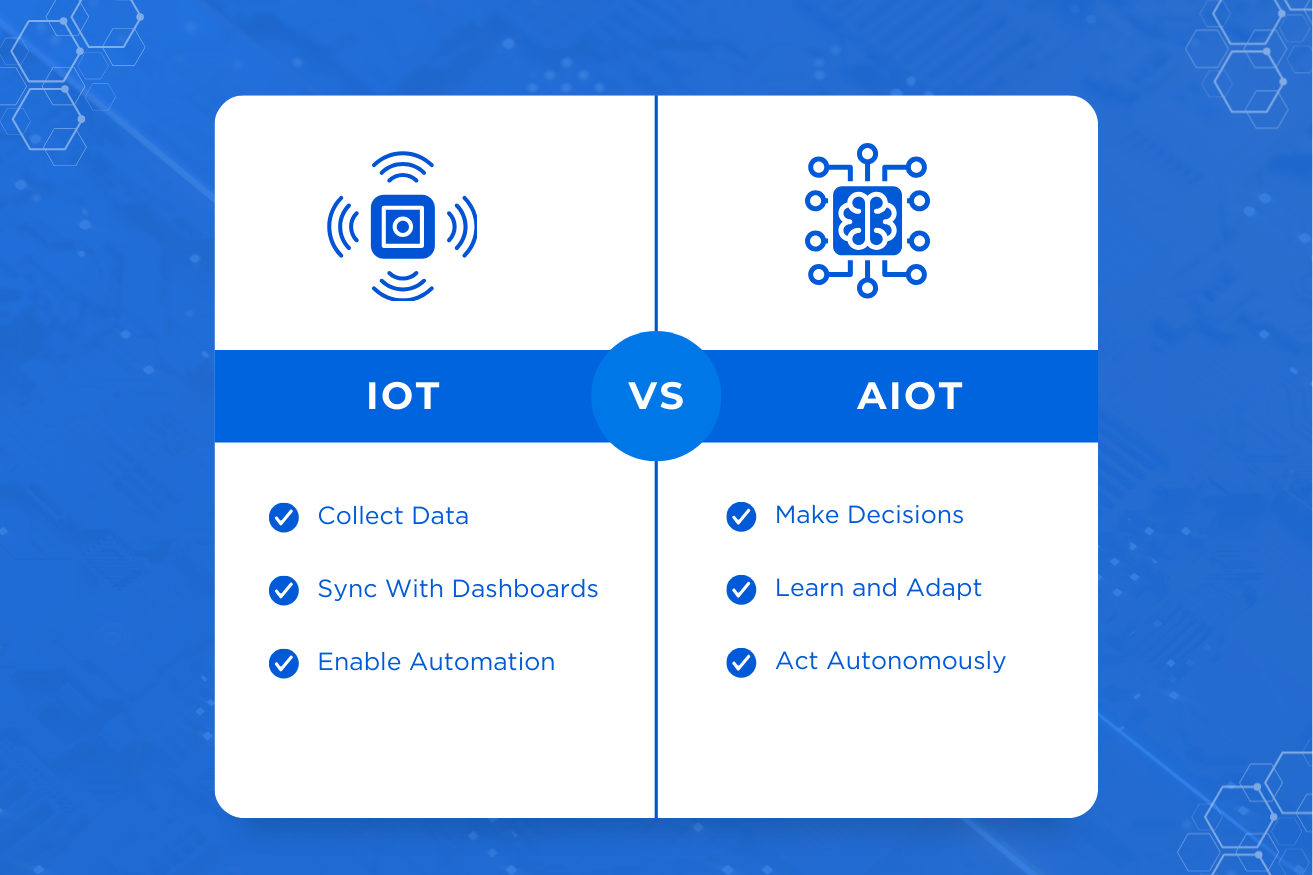
If your product simply connects devices and visualizes data, you are building IoT.
If it can learn, adapt, and act autonomously, you are building AIoT — and that is a
fundamentally different engineering problem.
What Traditional IoT Architecture Focuses On
Classic IoT systems are designed around connectivity and observability. Their primary goal is to
move data reliably from the physical world to software systems.
A typical IoT stack looks like this:
- Sensors generate telemetry
- Gateways aggregate and forward data
- Cloud platforms store, analyze, and visualize information
- Rule engines trigger alerts or basic automation
This approach works extremely well for:
- Monitoring and reporting
- Asset tracking
- Condition-based alerts
- Dashboard-driven decision-making
IoT excels at visibility. However, decision-making is usually external — handled by humans or
cloud-based logic.
Shared Foundations Between IoT and AIoT
Whether you are building IoT or AIoT, some principles are non-negotiable:
- Secure device identity and authentication
- Encrypted, reliable data transport
- Scalable data pipelines
- Consistent schemas and observability
- Interoperability across systems
These are the baseline requirements. They keep systems operational — but they don’t make them
intelligent.
What Makes AIoT Architecture Different
AIoT introduces decision-making as a first-class design concern. Instead of pushing all
intelligence to the cloud, AIoT systems distribute it across the stack — often closer to where
data is generated.
Key characteristics of AIoT systems include:
- Edge inference using lightweight, optimized models
- Local decision-making with minimal latency
- Reduced dependency on continuous cloud connectivity
- Feedback loops that allow systems to improve over time
The result is devices that don’t just report data — they interpret and act on it.
Edge Intelligence and Local Decisions
In AIoT, the edge is no longer just a data forwarder. Small, quantized models running on
embedded hardware allow devices to:
- Detect anomalies instantly
- Respond in milliseconds
- Operate during network outages
- Preserve privacy by processing data locally
This is critical for applications where latency, safety, or availability matters.
Feedback Loops and Continuous Learning
One of the most overlooked aspects of AIoT is learning in the field. Logs alone are not enough.
AIoT systems must be designed to:
- Capture outcomes of decisions
- Associate context (time, location, state)
- Feed validated results back into training pipelines
Without this, models stagnate and performance degrades over time.
Practical Design Lessons for Real-World AIoT
- Start With the Decision, Not the Sensor:
Define what action the system must take before choosing hardware or models. Intelligence
should serve decisions — not the other way around. - Inject Context Early:
Raw signals are rarely enough. Time, device state, environment, and user context turn
predictions into actionable outputs. - Be Edge-First Where It Matters:
If latency, privacy, or offline operation is required, cloud-only intelligence will fail. Push
logic closer to the source. - Separate Suggestions From Control:
AI outputs should be validated before triggering actuators. Human-in-the-loop or rule-based
gating improves safety and trust. - Treat OTA and Model Updates as Release Engineering:
Updating AI models in deployed devices is not trivial. Versioning, rollback, validation, and
governance must be planned from day one. - Design Observability for Decisions:
Telemetry tells you what happened. Decision observability tells you why. Without
explainability, systems become unmaintainable. - Build Security as a Foundation:
More autonomy increases attack surface. Certificates, encryption, secure boot, and key
rotation are essential for safe AIoT systems.
AIoT Is a Lifecycle Problem, Not a Feature
AIoT is not about adding a neural network to an existing IoT product. It requires rethinking:
- System architecture
- Data pipelines
- Update mechanisms
- Security models
- Operational workflows
Only when intelligence is treated as system design, not an add-on, do AIoT products scale
reliably in the real world.
Final Thoughts — Building AIoT That Ships
The most successful intelligent systems are not the ones with the most complex models. They are
the ones with clear decisions, strong data foundations, and disciplined engineering.
If you’re building beyond connected demos — toward systems that sense, decide, and act
autonomously — the architecture matters more than the algorithm.
At MetaDesk Global, we help teams design AIoT systems that work in production, not just in
slides.