




The Internet of Things (IoT) continues to transform industries by connecting physical devices with digital intelligence. From smart agriculture and healthcare monitoring to industrial automation and smart cities, IoT systems are becoming essential infrastructure for modern businesses.
As we move into 2026, the IoT landscape is evolving rapidly. The focus is no longer just about connecting devices — it’s about building intelligent, scalable, and reliable systems that operate autonomously in real-world environments.
In this article, we explore the key IoT trends shaping 2026 and how organizations can leverage these technologies to build smarter connected products.
The Evolution of IoT: From Connectivity to Intelligence
The early wave of IoT focused primarily on device connectivity — collecting data from sensors and sending it to the cloud. Today, the expectations are much higher. Modern IoT deployments require:
- Real-time intelligence
- Reliable long-term device operation
- Secure and scalable connectivity
- Efficient power management
- Integration with AI-driven analytics
Organizations are increasingly adopting AIoT (Artificial Intelligence of Things) — systems where IoT devices collect data and AI models analyze and automate decisions. This shift is redefining how IoT products are designed and deployed, building on the core 4 main components of IoT.
Key IoT Trends in 2026
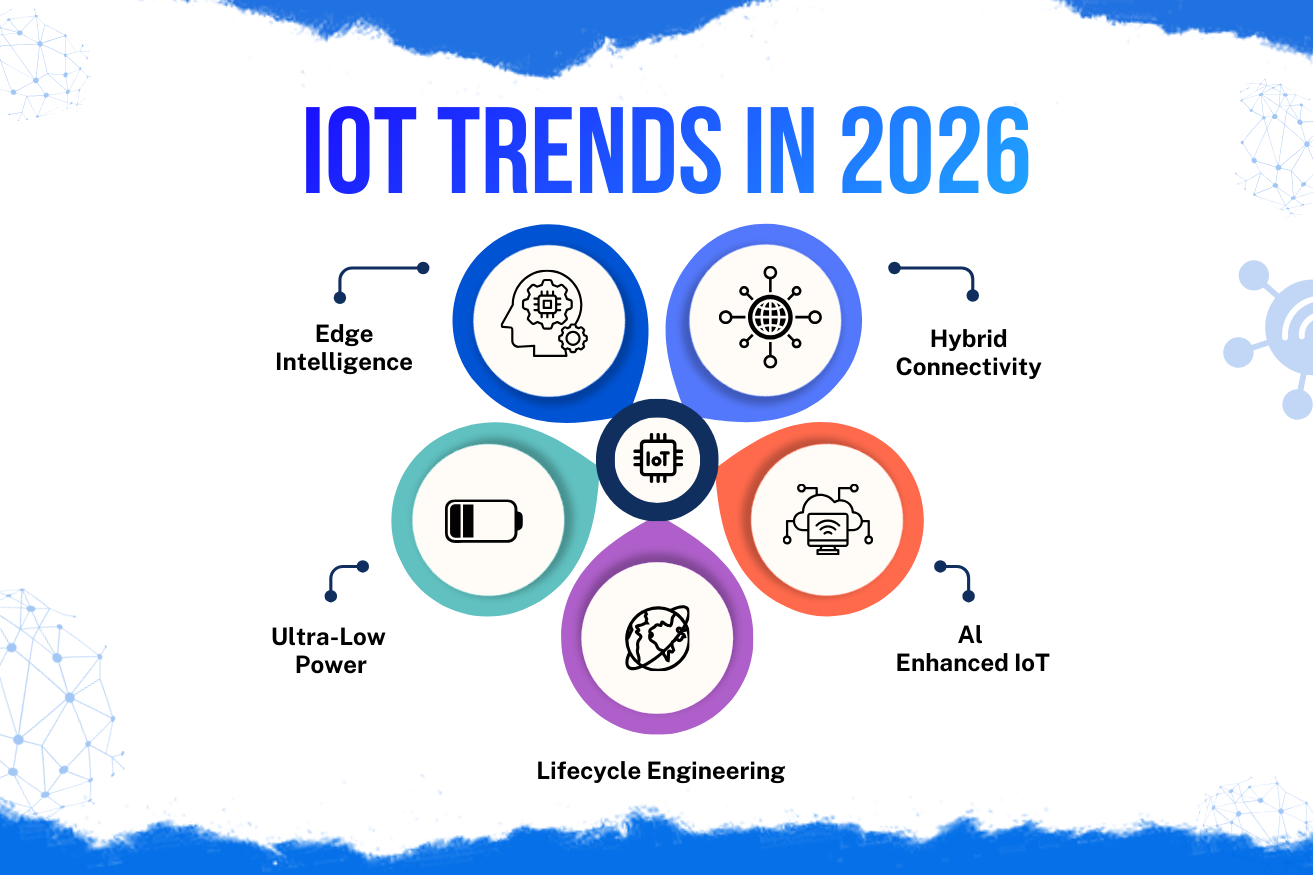
Several technological shifts are shaping the next generation of IoT systems. Below are the most important IoT trends to watch in 2026.
Edge Intelligence and On-Device Processing
One of the most significant trends in IoT architecture is the move toward edge intelligence. Traditionally, IoT devices transmitted data to the cloud for processing — but this introduced latency and increased bandwidth costs. Edge computing solves this by enabling devices to process data locally.
- Faster real-time decisions
- Lower cloud infrastructure costs
- Improved reliability in offline scenarios
- Enhanced privacy and security
Edge AI is increasingly important in industrial automation, agriculture, and healthcare monitoring, where immediate responses are critical — though it brings real Edge AI deployment challenges of its own.
Ultra-Low Power IoT Devices
Power consumption remains one of the biggest challenges in IoT product development. Many IoT devices operate in remote environments where frequent battery replacement is impractical, so engineers are focusing heavily on ultra-low-power system design.
- Event-driven firmware architecture
- Low-power microcontrollers and sensors
- Optimized wireless transmission intervals
- Advanced sleep modes and power management
These techniques allow IoT devices to operate for several years on a single battery, making large-scale deployments economically viable.
Hybrid Connectivity Architectures
No single communication technology can meet every IoT deployment requirement. As a result, modern IoT systems increasingly use hybrid connectivity models.
- Bluetooth Low Energy (BLE) – short-range device communication
- LoRa / LoRaWAN – long-range low-power networks
- NB-IoT / LTE-M – cellular IoT connectivity
- Wi-Fi / Wi-Fi HaLow – high bandwidth for local environments
Hybrid networks let companies balance coverage, power consumption, and infrastructure cost across different deployment scenarios — a key decision in your IoT deployment architecture.
Lifecycle Engineering for IoT Products
Another major trend shaping IoT in 2026 is the shift toward product lifecycle engineering. Many IoT projects fail because they focus too heavily on prototypes without considering long-term deployment challenges. Successful IoT systems must be designed for:
- High-volume manufacturing
- Remote firmware updates (OTA)
- Long-term component availability
- Field serviceability and diagnostics
Organizations that consider the entire lifecycle of their IoT products are far more likely to build scalable and profitable solutions.
AI-Enhanced IoT Systems (AIoT)
Artificial intelligence is increasingly becoming a core component of IoT systems. When combined with connected sensors, AI enables systems to analyze patterns, detect anomalies, and automate complex decisions.
- Predictive maintenance in industrial equipment
- Smart energy management systems
- Livestock and agriculture monitoring
- Smart city infrastructure optimization
- Healthcare wearable devices
AIoT transforms raw data from connected devices into actionable insights and automated operations.
Security and Reliability in Modern IoT Systems
As the number of connected devices grows, security has become a critical concern. IoT deployments must address challenges such as:
- Device authentication and identity management
- Secure firmware updates
- Data encryption and privacy protection
- Resilient network architecture
Organizations that design IoT systems with security-first principles will be better positioned to scale safely.
The Future of IoT Beyond 2026
Looking ahead, IoT systems will continue evolving toward greater intelligence and autonomy. Future innovations may include:
The next generation of IoT will not only collect data — it will analyze, learn, and act independently. To get there, teams increasingly rely on proven IoT system design patterns and continuous monitoring of the right IoT platform KPIs.
Building Reliable IoT Solutions
At MetaDesk Global, we work with companies building connected products across industries including agriculture, industrial automation, healthcare, and smart infrastructure. Our engineering teams focus on designing IoT systems that are:
- Reliable in real-world environments
- Optimized for ultra-low power operation
- Scalable for global deployments
- Built with secure and resilient architectures
Developing successful IoT products requires expertise across hardware engineering, embedded firmware development, connectivity architecture, and cloud integration.
Frequently Asked Questions
Conclusion
The Internet of Things is entering a new era where connectivity alone is no longer enough. In 2026, successful IoT systems will combine edge intelligence, hybrid connectivity, low-power hardware, and AI-driven analytics to deliver real value.
Organizations that invest in these technologies will be able to build connected systems that are smarter, more reliable, and capable of operating autonomously in the real world.