Many IoT systems today look impressive on the surface — connected devices, real-time dashboards, and clean visualizations.
But behind the scenes, most of them are not truly intelligent.
A common misconception in the industry is that adding a dashboard or analytics layer makes a system “smart” or even autonomous. In reality, dashboards only show what has already happened — they don’t make decisions, trigger actions, or improve the system over time.
True autonomy in IoT systems comes from architecture, not visualization.
This article explains the layered approach required to build real AIoT systems that can sense, decide, act, and continuously improve.
What is an Autonomous IoT System?
An autonomous IoT system goes beyond monitoring.
It:
- Collects real-world data
- Processes and analyzes it
- Makes intelligent decisions
- Executes actions automatically
- Learns and improves over time
This requires multiple tightly integrated layers — not just connectivity and dashboards.
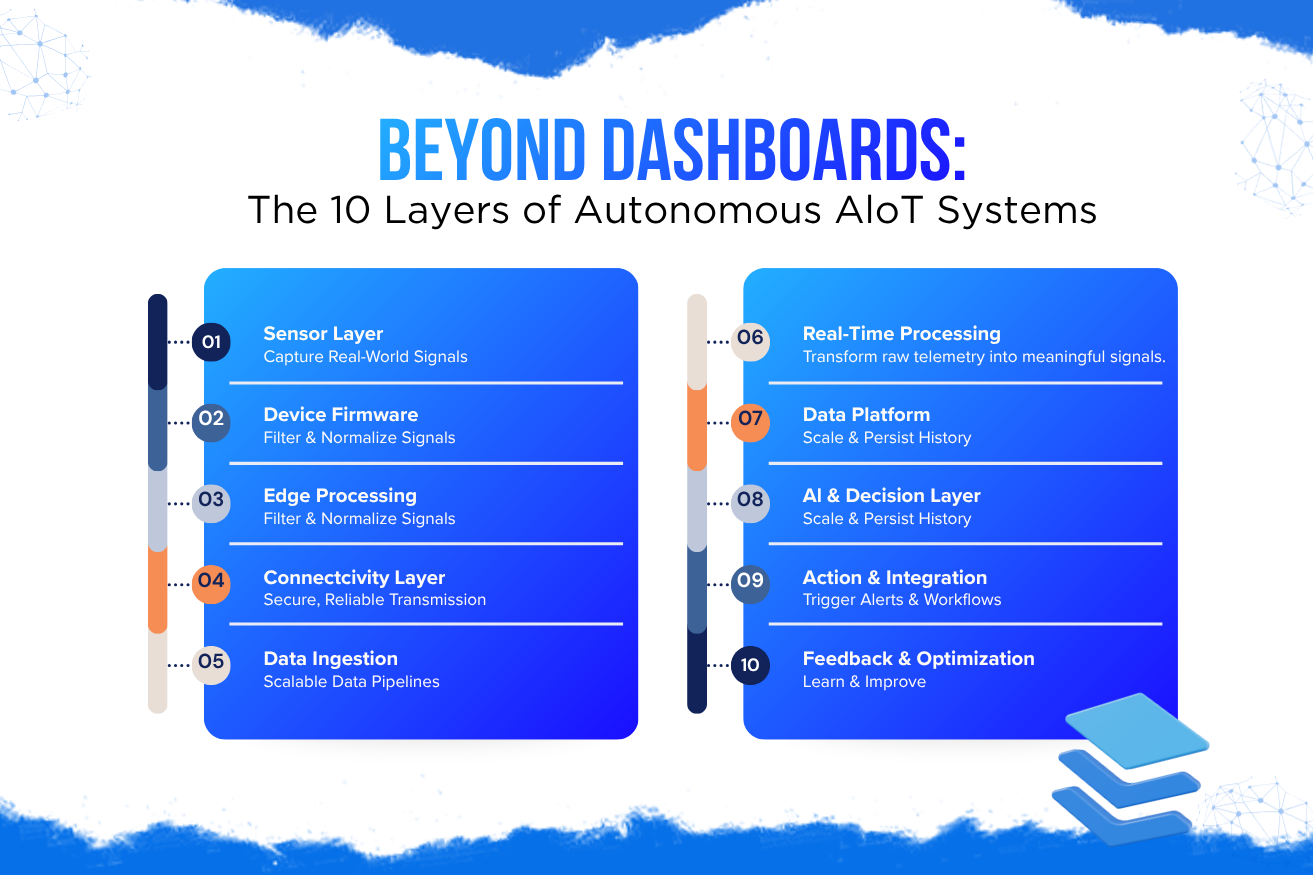
The 10 Essential Layers of an Autonomous AIoT System
To move from a “connected system” to an “intelligent system,” every layer must be designed with intention.
1. Sensor Layer: The Foundation of Data Quality
All intelligence begins with accurate data.
Sensors capture real-world signals such as temperature, motion, pressure, or current. If this data is noisy, inconsistent, or poorly calibrated, every layer above it will be affected.
Key Focus:
- Sensor selection and calibration
- Noise reduction
- Reliable signal acquisition
2. Device Firmware: First Line of Processing
Firmware acts as the first filter between raw signals and the system.
It is responsible for:
- Data normalization
- Basic validation
- Device-level control logic
Well-designed firmware prevents unnecessary data from flooding the system.
3. Edge Computing: Real-Time Intelligence
Edge computing enables devices to process data locally.
This is critical for:
- Low-latency decision-making
- Offline operation during network failures
- Reducing dependency on cloud infrastructure
Example: Detecting machine faults instantly without waiting for cloud analysis.
4. Connectivity Layer: Reliable Data Transmission
Data must move securely and reliably between devices and cloud systems.
Choosing the right communication protocol depends on:
- Environment (industrial, remote, urban)
- Bandwidth requirements
- Power constraints
Protocols like MQTT, HTTP, CoAP, and cellular communication play key roles here.
5. Data Ingestion: Scalable Data Collection
Once data reaches the backend, it must be ingested efficiently.
A robust ingestion layer ensures:
- No data loss during peak loads
- Proper handling of high-frequency streams
- Structured data entry into pipelines
6. Real-Time Processing: From Data to Signals
Raw telemetry is not useful until it is processed.
This layer:
- Detects anomalies
- Filters noise
- Generates meaningful events
It transforms raw data into actionable insights in real time.
7. Data Platform: Storage and Scalability
An effective data platform stores both real-time and historical data.
It must:
- Scale with the number of devices
- Support structured and unstructured data
- Enable fast querying and analytics
This is essential for long-term intelligence and reporting.
8. AI and Decision Layer: Intelligence Core
This is where data becomes intelligence.
AI models analyze patterns, while decision engines combine:
- Machine learning outputs
- Business rules
- Operational constraints
Without decision logic, AI models alone cannot drive real-world actions.
9. Action and Integration Layer: Closing the Loop
Insights must lead to action.
This layer:
- Triggers alerts and workflows
- Adjusts system behavior automatically
- Integrates with enterprise systems like ERP, MES, and CRM
Without execution, intelligence remains theoretical.
10. Feedback Loop and Optimization: Continuous Learning
The final layer is what separates static systems from adaptive ones.
It:
- Feeds real-world outcomes back into the system
- Improves model accuracy over time
- Enables continuous optimization
This is where true autonomy emerges.
Why Dashboards Alone Are Not Enough
Dashboards are valuable for visibility — but they are only one small part of the system.
They:
- Display historical and real-time data
- Help humans understand system behavior
But they do not:
- Make decisions
- Trigger actions
- Improve system performance automatically
Relying solely on dashboards leads to reactive systems instead of intelligent ones.
Building Real AIoT Systems: Best Practices
- Design for Full-Stack Intelligence
Think beyond connectivity and dashboards — design every layer intentionally.
- Prioritize Data Quality
Garbage data leads to unreliable intelligence.
- Implement Edge + Cloud Hybrid Architecture
Combine real-time edge processing with cloud-scale intelligence.
- Enable Secure OTA Updates
Continuously update firmware and AI models safely.
- Build Feedback Loops Early
Systems should learn and improve from day one.
Conclusion: Autonomy is Built, Not Added
Autonomous IoT systems are not created by adding a dashboard or deploying a single AI model.
They are built through a layered architecture, where each component contributes to sensing, processing, decision-making, and continuous improvement.
Dashboards show you what’s happening.
Autonomous systems decide what to do next — and do it.
About MetaDesk Global
MetaDesk Global specializes in building end-to-end AIoT systems — from embedded firmware and hardware design to scalable cloud architectures and intelligent automation.
We help companies move beyond dashboards and build real-world autonomous systems that perform reliably at scale.