Connected devices are transforming industries through IoT and AIoT systems that enable real-time monitoring, automation, predictive maintenance, and intelligent decision-making.
But as connected products become more powerful, they also become larger attack surfaces.
From smart industrial gateways and embedded devices to cloud-connected edge systems, modern IoT infrastructure introduces security risks across every layer of the architecture.
At MetaDesk Global, we’ve seen that most IoT security failures are not caused by a single bug.
👉 They happen because security ownership was fragmented across the system.
This article explores:
- Why IoT security requires a full-stack architecture approach
- The critical security layers in connected products
- Common vulnerabilities in IoT systems
- Best practices for building secure AIoT and embedded systems at scale
Why IoT Security Is Different From Traditional IT Security
Traditional IT systems mainly protect:
- Servers
- Applications
- Cloud infrastructure
- User access
IoT and AIoT systems introduce additional risks because they combine:
- Physical hardware
- Embedded firmware
- Wireless communication
- Edge computing
- Cloud platforms
- OTA infrastructure
Unlike traditional software systems, IoT devices operate:
- In uncontrolled environments
- Across unstable networks
- With physical access exposure
- Over long deployment lifecycles
This means security must extend from:
👉 Silicon → Firmware → Connectivity → Cloud → Operations
The Biggest Problem in IoT Security
One of the most common issues in connected-product development is fragmented responsibility.
Teams often secure:
- APIs
- Dashboards
- Cloud infrastructure
while overlooking:
- Firmware updates
- Device identity
- Gateway hardening
- Certificate rotation
- OTA infrastructure
As a result, attackers frequently target the layers nobody actively owns.
Why IoT Security Must Be Full-Stack
Secure IoT products require protection across every architectural layer.
Security cannot be treated as:
- A final deployment checklist
- A cloud-only responsibility
- A compliance checkbox
Instead, it must be integrated into the product lifecycle from the beginning.
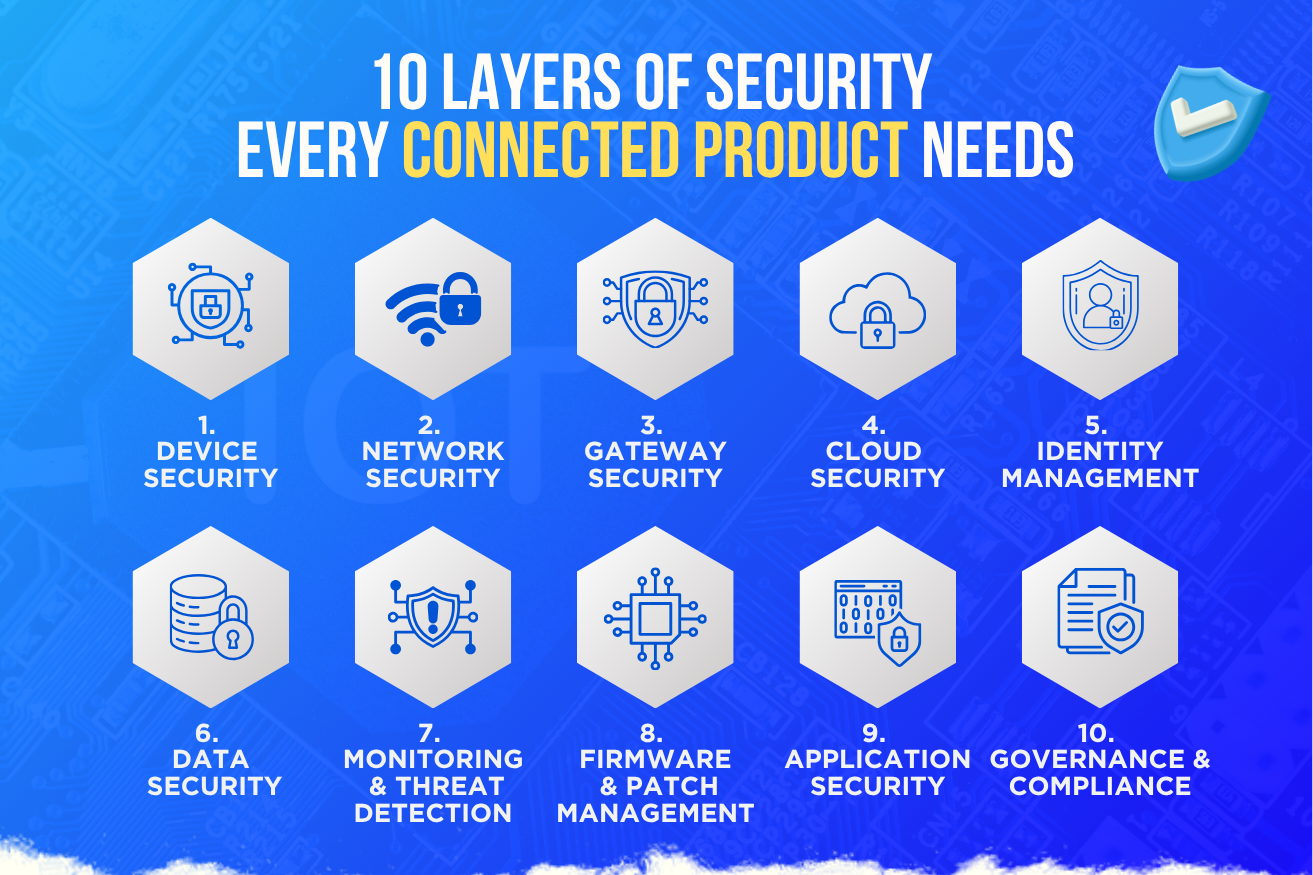
1. Device Security: Building Trust From the Hardware Layer
Connected devices are physical endpoints that can be:
- Tampered with
- Reverse engineered
- Cloned
- Accessed directly
This makes device-level security foundational.
Essential Device Security Features
Secure Boot
Ensures only trusted firmware images can run on the device.
Hardware Root of Trust
Establishes device identity directly at the hardware level.
Signed Firmware
Prevents unauthorized firmware execution.
Flash Encryption
Protects firmware and sensitive data stored in memory.
Why Device Security Matters
If the device itself cannot be trusted:
- Cloud security becomes irrelevant
- OTA systems become vulnerable
- Entire fleets become exposed
2. Network Security in IoT Systems
IoT systems continuously exchange telemetry and control data across networks.
Without secure communication:
- Device traffic can be intercepted
- Commands can be manipulated
- Sensitive operational data can leak
Best Practices for IoT Network Security
Mutual TLS (mTLS)
Authenticates both client and server.
MQTT Over TLS
Protects messaging infrastructure.
DTLS for UDP Systems
Secures lightweight datagram communication.
WPA3 and Secure Wi-Fi Standards
Protect wireless access points and local connectivity.
Key Principle:
👉 Encryption should be enabled by default — not added later.
3. Gateway Security: The Overlooked Attack Surface
IoT gateways often aggregate:
- Devices
- Protocols
- Edge processing
- Cloud communication
Because of this, gateways become high-value targets.
Common Gateway Risks
- Weak operating system hardening
- Exposed ports
- Shared workloads
- Lateral movement between services
Gateway Security Best Practices
OS Hardening
Remove unnecessary services and restrict access.
Workload Isolation
Separate critical services using containers or virtualization.
Network Segmentation
Limit communication between internal services.
Continuous Monitoring
Track unusual lateral traffic and behavior.
4. Cloud Security for IoT Platforms
Cloud infrastructure processes and stores massive amounts of IoT telemetry.
This includes:
- Device data
- AI inference outputs
- Operational analytics
- User workflows
Cloud Security Requirements
- Private VPC Infrastructure
- Managed Encryption Keys
- Multi-Tenant Isolation
- Secure APIs
Common Platforms
- AWS IoT Core
- Azure IoT Hub
- Google Cloud IoT
5. Identity and Access Management (IAM)
Every connected device should have a unique identity.
Using:
- Shared credentials
- Static passwords
- Long-lived secrets
creates major security risks.
Best Practices for IoT IAM
- Per-Device Certificates
- Scoped Permissions
- Certificate Rotation
- Short-Lived Credentials
6. Data Security in AIoT Systems
IoT systems generate large volumes of operational and behavioral data.
This data often includes:
- Sensitive telemetry
- Location information
- Industrial process data
- Operational intelligence
Data Security Best Practices
- Encryption in Transit
- Encryption at Rest
- Field-Level Encryption
- Key Rotation Policies
7. Monitoring and Threat Detection
Traditional monitoring focuses on infrastructure health.
AIoT systems require behavioral monitoring.
Why Behavioral Monitoring Matters
Compromised devices often behave differently before failure occurs.
Examples:
- New DNS requests
- Unusual bandwidth usage
- Unexpected endpoint communication
- Abnormal telemetry patterns
AIoT Security Monitoring Includes
- Device Behavior Analytics
- Fleet-Wide Threat Detection
- Continuous Logging
8. Firmware and OTA Security
One of the largest IoT attack surfaces is the firmware update pipeline.
Many vulnerabilities persist because:
👉 Organizations struggle to patch devices reliably at scale.
Secure OTA Requirements
- Signed Updates
- Rollback Protection
- Staged Deployment
- Recovery Mechanisms
Why OTA Security Matters
A compromised OTA system can:
- Infect entire device fleets
- Disrupt operations globally
- Destroy customer trust
9. Application Security
IoT products include:
- Mobile apps
- Dashboards
- APIs
- Control panels
These become operational attack surfaces.
Common Risks
- Weak authentication
- Broken access control
- API injection vulnerabilities
- Insecure session handling
Important Framework
The OWASP API Top 10 remains highly relevant for IoT applications.
10. Governance and Compliance
IoT security regulations are evolving rapidly.
Organizations now face increasing pressure to comply with frameworks such as:
- EU Cyber Resilience Act (CRA)
- NIST 8259
- IEC 62443
Why Compliance Matters
Security is no longer optional.
It is becoming:
- A procurement requirement
- A regulatory expectation
- A market access condition
Why Secure IoT Systems Require Ownership
One of the biggest lessons in connected-product development is this:
👉 Every security layer needs a clear owner.
Without ownership:
- Updates stop happening
- Certificates expire
- Monitoring weakens
- Vulnerabilities remain unpatched
Security failures often happen not because protections don’t exist — but because no team fully owns them.
Best Practices for Building Secure IoT and AIoT Systems
1. Design Security Early
Security must begin during:
- Hardware design
- Firmware architecture
- Cloud infrastructure planning
2. Secure the Full Stack
Protect:
- Devices
- Networks
- Gateways
- Cloud systems
- Applications
- OTA infrastructure
3. Build Continuous Update Infrastructure
Secure OTA systems are essential for:
- Vulnerability response
- Feature evolution
- Long-term maintenance
4. Implement Behavioral Monitoring
Monitor:
- Device behavior
- Fleet activity
- Operational anomalies
5. Treat Compliance as Engineering
Modern regulations increasingly require:
- Security-by-design
- Documented software supply chains
- Vulnerability management workflows
Conclusion
Most connected-product breaches do not begin at the cloud layer.
They begin at:
- Firmware update pipelines
- Device identity systems
- Gateway infrastructure
- Unsecured communication layers
The organizations building secure AIoT systems understand that:
👉 Security is not a feature added before launch.
It is an architectural commitment made before the first device ever leaves the factory.
The future of connected products belongs to systems that are:
- ✔ Secure by design
- ✔ Continuously updateable
- ✔ Operationally resilient
- ✔ Built with full-stack trust in mind
About MetaDesk Global
MetaDesk Global specializes in embedded systems, AIoT architecture, IoT security, firmware development, PCB design, and secure connected-product engineering.
We help organizations build production-ready IoT systems designed for scalability, resilience, and long-term operational security.