



As AI becomes increasingly embedded into IoT devices, organizations face a growing challenge:
How do you train better AI models when the data cannot leave the device, facility, or organization?
Traditional machine learning relies on collecting data from thousands of sources and centralizing it in the cloud. While effective, this approach introduces concerns around:
- Data privacy
- Regulatory compliance
- Bandwidth costs
- Data ownership
- Security risks
Federated Learning offers a different approach.
Instead of moving data to a central model, the model is distributed to where the data already exists.
For industries adopting AIoT, Edge AI, and intelligent connected systems, Federated Learning is becoming a key architectural strategy for building privacy-preserving AI at scale.
In this article, we explore the major Federated Learning architectures, their advantages, challenges, and real-world applications.
What Is Federated Learning?
Federated Learning (FL) is a distributed machine learning approach where multiple devices or organizations collaboratively train a shared model without transferring raw data to a central server.
The process typically works as follows:
- A global model is distributed to participants.
- Each participant trains locally using its own data.
- Only model updates are shared.
- Updates are aggregated into a new global model.
- The cycle repeats continuously.
The result is a continuously improving AI model without centralized access to sensitive data.
Why Federated Learning Matters for AIoT Systems
Modern AIoT systems generate enormous amounts of data from:
- Smart sensors
- Industrial equipment
- Medical devices
- Autonomous vehicles
- Edge gateways
- Smart buildings
- Manufacturing systems
In many cases, moving all of this data to the cloud is impractical because of:
Privacy Requirements
Sensitive data often falls under regulations such as:
- GDPR
- HIPAA
- PCI-DSS
- Cyber Resilience Act (CRA)
Bandwidth Limitations
Large-scale deployments may generate terabytes of data daily.
Transmitting everything to the cloud can become expensive and inefficient.
Edge Intelligence Requirements
Many systems require local processing for:
- Low latency
- Offline operation
- Real-time decision-making
Federated Learning enables AI systems to continuously improve while keeping intelligence close to the source.
Benefits of Federated Learning
Federated Learning offers several advantages over traditional centralized machine learning.
Enhanced Data Privacy
Raw data never leaves local devices or organizations.
This reduces exposure risks and improves compliance.
Reduced Network Traffic
Only model updates are exchanged instead of entire datasets.
This significantly lowers bandwidth consumption.
Better Regulatory Compliance
Organizations maintain control over sensitive data while still benefiting from collaborative AI training.
Scalable AI Training
Large fleets of devices can contribute to model improvement without centralizing data.
Faster Edge AI Adoption
Federated Learning complements Edge AI by enabling continuous learning directly at the edge.
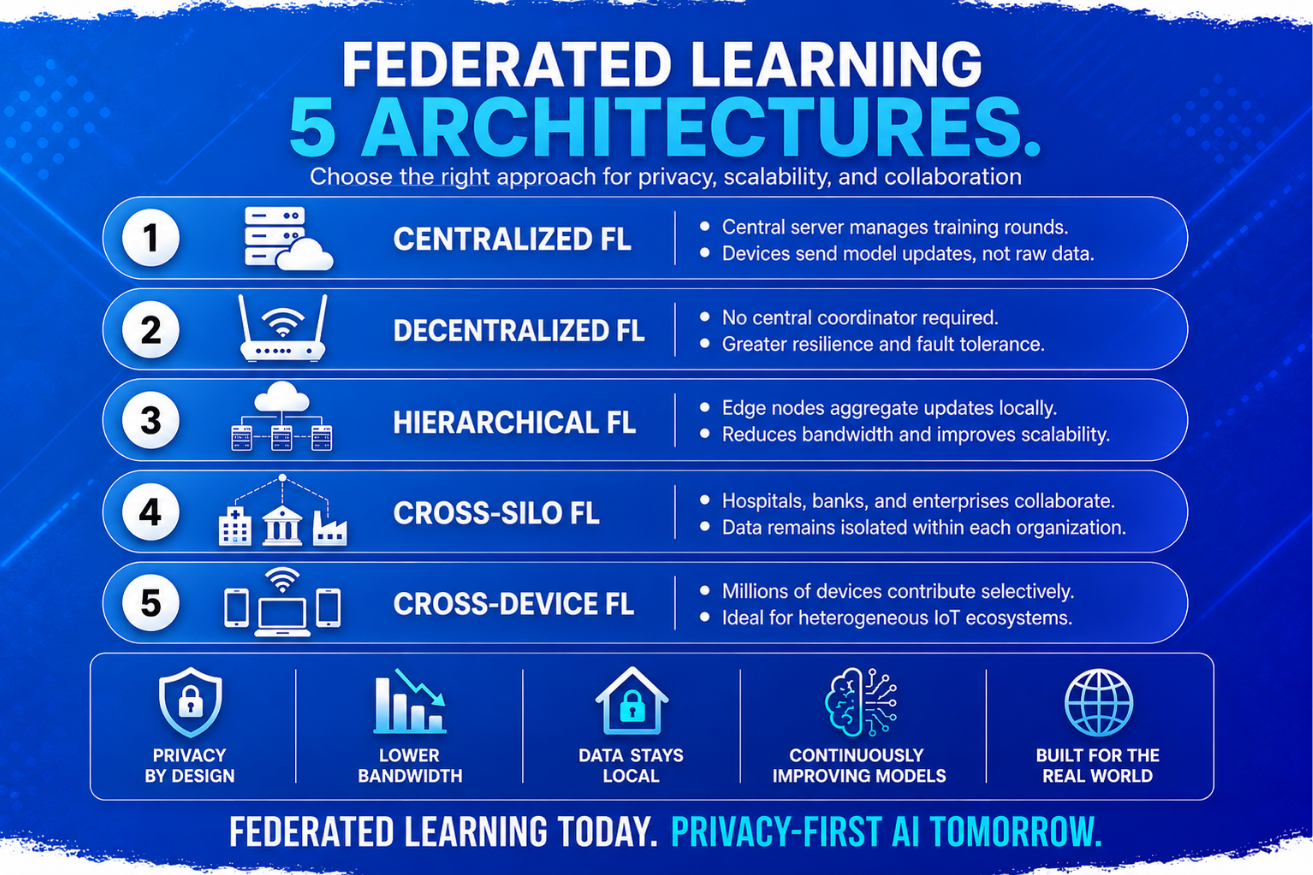
1. Centralized Federated Learning
This is the most common Federated Learning architecture.
How Centralized Federated Learning Works
A central server coordinates the entire learning process.
The server:
- Distributes global models
- Receives local updates
- Aggregates results
- Generates new model versions
Participants never exchange data directly.
Advantages
Simple Orchestration
Easy to manage and monitor.
Mature Ecosystem
Supported by frameworks such as:
- TensorFlow Federated
- Flower
- FedML
Easier Governance
Central coordination simplifies deployment.
Challenges
Single Point of Failure
The central coordinator becomes critical infrastructure.
Scalability Constraints
Large deployments may place significant load on the server.
Best Use Cases
- Enterprise AI systems
- Industrial IoT deployments
- Controlled AI environments
2. Decentralized Federated Learning
Decentralized Federated Learning removes the central coordinator.
How It Works
Devices communicate directly with one another.
Model updates are exchanged among participants and gradually converge toward a shared model.
Advantages
Improved Resilience
No central server dependency.
Better Fault Tolerance
The system continues functioning even if individual participants fail.
Reduced Infrastructure Requirements
Less centralized compute is needed.
Challenges
Complex Coordination
Synchronization becomes more difficult.
Monitoring Difficulties
Model visibility and governance become more challenging.
Best Use Cases
- Distributed edge networks
- Mesh architectures
- Resilient AI infrastructures
3. Hierarchical Federated Learning
Hierarchical FL introduces intermediate aggregation layers.
How Hierarchical FL Works
Instead of sending updates directly to the cloud:
Devices → Edge Gateways → Cloud
Edge nodes aggregate updates locally before forwarding them upstream.
Advantages
Reduced Bandwidth Usage
Fewer updates reach the cloud.
Improved Scalability
Large deployments become easier to manage.
Faster Local Learning
Regional optimization improves responsiveness.
Challenges
Additional Infrastructure
Requires gateway-level intelligence.
More Complex Architecture
Multiple aggregation layers increase complexity.
Best Use Cases
- Smart factories
- Utility networks
- Smart cities
- Industrial AIoT systems
4. Cross-Silo Federated Learning
Cross-Silo FL focuses on collaboration between trusted organizations.
How It Works
Organizations train models collaboratively while keeping their data isolated.
Examples include:
- Hospitals
- Banks
- Manufacturing companies
- Research institutions
Each participant contributes updates rather than raw data.
Advantages
Strong Privacy Protection
Sensitive data remains within organizational boundaries.
Regulatory Compliance
Supports highly regulated industries.
Shared Intelligence
Organizations benefit from larger training datasets.
Challenges
Governance Complexity
Participants must agree on training rules.
Trust Management
Organizations need secure collaboration frameworks.
Best Use Cases
- Healthcare AI
- Financial services
- Industrial consortiums
- Research collaborations
5. Cross-Device Federated Learning
Cross-Device FL focuses on large-scale fleets of edge devices.
How It Works
Thousands or millions of devices contribute to model training.
Examples include:
- Smartphones
- Smart sensors
- IoT gateways
- Consumer electronics
Only a subset of devices participates in each training round.
Advantages
Massive Scalability
Supports enormous device fleets.
Continuous Learning
Models improve using real-world operational data.
Strong Privacy
Data remains local to the device.
Challenges
Device Reliability
Participants may frequently disconnect.
Variable Compute Resources
Devices have different capabilities.
Synchronization Complexity
Training participation changes continuously.
Best Use Cases
- Consumer AI applications
- Smart home ecosystems
- Large-scale IoT deployments
- Edge AI products
Federated Learning vs Traditional Machine Learning
| Feature | Traditional ML | Federated Learning |
|---|---|---|
| Data Location | Centralized | Distributed |
| Privacy | Lower | Higher |
| Bandwidth Usage | High | Lower |
| Compliance | More Complex | Easier |
| Scalability | Centralized Infrastructure | Distributed Infrastructure |
| Edge AI Support | Limited | Excellent |
How Federated Learning Supports Edge AI
Federated Learning and Edge AI are highly complementary technologies.
Edge AI enables:
- Local inference
- Real-time decisions
- Offline operation
Federated Learning enables:
- Continuous model improvement
- Privacy-preserving learning
- Distributed intelligence
Together they create intelligent systems that can:
- Learn locally
- Improve globally
- Protect sensitive data
- Scale efficiently
Real-World Federated Learning Applications
Federated Learning is increasingly used in:
Healthcare
Hospitals collaborate on AI models without sharing patient records.
Manufacturing
Factories train predictive maintenance models while keeping operational data private.
Smart Cities
Distributed infrastructure learns from traffic, utilities, and environmental systems.
Financial Services
Banks improve fraud detection without exposing customer data.
Industrial IoT
Edge devices continuously improve anomaly detection and operational optimization.
Challenges of Federated Learning
Despite its benefits, Federated Learning introduces several engineering challenges.
Model Poisoning Risks
Malicious participants may attempt to influence model updates.
Communication Overhead
Model synchronization still requires network resources.
Device Heterogeneity
Participants often have different hardware capabilities.
Aggregation Complexity
Combining updates efficiently becomes difficult at scale.
Best Practices for Federated Learning Deployments
Organizations should:
Define Privacy Requirements Early
Understand compliance obligations before choosing an architecture.
Choose the Right Aggregation Strategy
The location of aggregation impacts scalability and security.
Secure Model Updates
Protect training pipelines using encryption and authentication.
Monitor Model Drift
Continuously evaluate model quality across participants.
Combine Federated Learning with Edge AI
Leverage local intelligence while improving global performance.
Conclusion
Federated Learning is not simply a privacy feature.
It is an architectural approach that fundamentally changes how AI systems learn and evolve.
The most important design decisions are not about whether data stays local.
They are about:
- Where aggregation happens
- Who coordinates learning
- How participants communicate
- How systems scale
- How trust is established
Whether using:
- Centralized FL
- Decentralized FL
- Hierarchical FL
- Cross-Silo FL
- Cross-Device FL
The goal remains the same:
Build intelligent systems that learn collaboratively without compromising privacy, security, or operational efficiency.
As AIoT and Edge AI continue to expand, Federated Learning will play a critical role in creating scalable, privacy-preserving intelligent systems.
About MetaDesk Global
MetaDesk Global specializes in:
- AIoT Solutions
- Edge AI Systems
- Embedded Firmware Development
- Industrial IoT Platforms
- PCB Design
- Federated Learning Architectures
- Intelligent Connected Product Development
We help organizations build scalable AI systems that combine edge intelligence, privacy, and real-world operational reliability.