


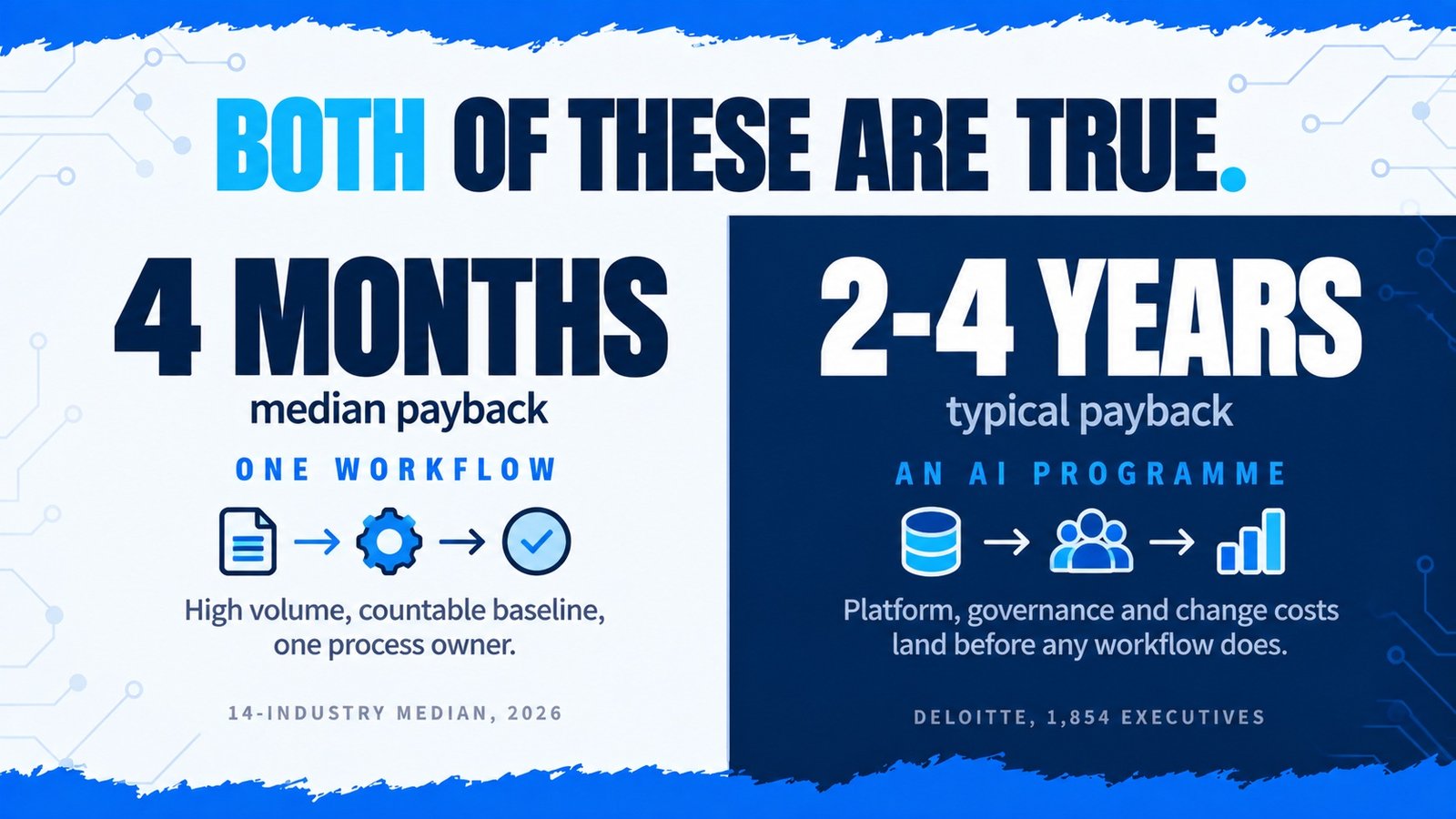
Search for AI automation ROI and you will find two sets of figures that appear to contradict each other. One says payback arrives in about four months and first-year returns of 200 to 400 percent are normal. The other, from Deloitte’s survey of more than 1,800 executives, says typical AI payback runs two to four years — three to four times longer than conventional technology projects.
Both are accurate. They are measuring different things, and knowing which one applies to you is the difference between a business case that holds up and one that quietly collapses in month eight. This guide separates them, then shows how to calculate a number for your own process.
Why Both Sets of Numbers Are True
The fast figures describe a single automated workflow: one high-volume process, clear rules, measurable hours. The slow figures describe an AI programme: a platform, a strategy, a governance framework, several departments, and a transformation nobody can point at a stopwatch for.
| One workflow | An AI programme | |
|---|---|---|
| What is measured | Hours on one process | Organisation-wide productivity |
| Typical payback | 3–6 months | 2–4 years |
| First-year return | 200–400% on stable, repeated work | Often negative |
| Why it is fast or slow | The baseline is known and the saving is countable | Platform, governance and change costs land before any workflow does |
| Risk | Contained to one process | Compounds across every workstream |
The wider picture across 2026 research is sobering but not discouraging: 84 percent of companies report positive ROI on AI investments overall, and the median return across three years lands somewhere around 300 percent. But only about 28 percent of enterprise use cases fully meet their ROI expectations, 41 percent reach payback within twelve months, and 19 percent never reach it at all.
Nearly one project in five never pays back. The way to not be in that fifth is to make the first project small enough that its return is countable.
Working Out ROI for One Process
Here is a complete calculation for a support team triaging inbound tickets. Substitute your own figures; the structure is what matters.
- 3,000 tickets a month
- 4 minutes each to read, categorise, tag and route — 200 hours a month
- Loaded cost of $26 an hour — $5,200 a month
- 85 percent classify and route correctly with no human involvement
- 450 tickets escalate for review at 1.5 minutes each — 11 hours a month
- Labour falls to about 11 hours, saving 189 hours or $4,914 a month
- Running costs — model usage, hosting, monitoring — $450 a month
- Net saving: roughly $4,460 a month
- Build cost: $18,000
- Payback: $18,000 ÷ $4,460 = about 4 months
- First-year net: ($4,460 × 12) − $18,000 = $35,520
- First-year ROI: about 197 percent
That lands at the lower end of the 200 to 400 percent band often quoted, which is roughly where an honest calculation usually lands once the running costs and the exception time are included. The published benchmarks tend to assume both away.
What Business Cases Usually Leave Out
What to Expect by Process Type
Reported 2026 medians put overall payback at about 4.2 months across fourteen industries, with customer service the fastest at roughly 4.1 months. The pattern below is consistent across the published data: speed tracks how countable the baseline is, not how clever the technology is.
| Process | Typical payback | Why |
|---|---|---|
| Ticket triage and routing | Fast | High volume, clear outcome, easily measured baseline |
| Document and invoice intake | Fast | Countable per-document cost, well-understood validation |
| Report and pack generation | Moderate | Lower frequency, but the manual effort is large and predictable |
| Quote and RFQ preparation | Moderate | Saving is real but the baseline varies between people |
| Cross-system reconciliation | Moderate | Integration-heavy, so more of the cost lands before any saving |
| Enterprise-wide AI programme | Slow | Platform and governance costs arrive first, benefits last |
Our breakdown of what AI automation costs covers the other half of this equation, and document processing automation works through the straight-through rate that drives most of these numbers.
Making the Number Defensible
Frequently Asked Questions
Conclusion
The four-month payback and the four-year payback are both real. One belongs to a single workflow with a measured baseline; the other belongs to a programme whose costs arrive long before its benefits. Decide which you are funding before you quote either figure to anyone.
If it is the first, the arithmetic is straightforward and worth doing honestly: baseline hours, exception hours, running costs, build cost. If the number still works after the omissions are added back, you have a business case rather than a hope. We scope automation projects around exactly that calculation, and say so when it does not add up.