Artificial Intelligence of Things (AIoT) is transforming modern industries by combining connected devices with intelligent automation.
From industrial automation and predictive maintenance to smart infrastructure and autonomous operations, AIoT promises systems that can:
- Sense
- Analyze
- Decide
- Act
- Continuously improve
Yet despite heavy investment, many AIoT initiatives fail to deliver long-term value.
Surprisingly, the issue is often not the AI model itself.
The real failure happens when organizations try to move from visibility systems to decision systems.
At MetaDesk Global, we’ve seen this pattern repeatedly across enterprise deployments.
Teams successfully connect devices, build dashboards, and generate analytics — but critical operational decisions still depend entirely on humans.
This article explores:
- Why AIoT systems fail to mature
- The stages of AIoT evolution
- The architectural shifts required to move from monitoring to autonomy
- How to design scalable, resilient AIoT systems that work in production
What is AIoT?
AIoT (Artificial Intelligence of Things) combines:
- IoT infrastructure
- Edge computing
- Artificial intelligence
- Real-time analytics
- Automation systems
Unlike traditional IoT platforms that focus mainly on monitoring and data collection, AIoT systems are designed to make intelligent operational decisions automatically.
The Real Problem: Visibility Without Intelligence
Most IoT systems stop at visibility.
Typical deployments include:
- Sensors and connected devices
- Cloud dashboards
- Alert pipelines
- Monitoring systems
This creates the impression of digital transformation because organizations can finally “see” operational data in real time.
But visibility alone does not create intelligence.
A dashboard showing an anomaly is still dependent on:
- Human interpretation
- Human escalation
- Human decision-making
- Human action
This creates operational bottlenecks that prevent systems from scaling effectively.
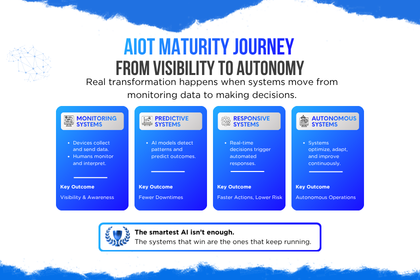
The AIoT Maturity Journey
Successful AIoT systems evolve through multiple stages.
Each stage introduces new levels of intelligence, automation, and operational complexity.
Stage 1: Monitoring Systems
At the beginning, organizations focus on connected visibility.
Characteristics
- Sensors collect telemetry
- Devices stream data
- Dashboards visualize system status
- Humans interpret insights manually
Common Technologies
- MQTT
- AWS IoT Core
- Azure IoT Hub
- Grafana
- Node-RED
Benefits
- Real-time operational visibility
- Improved monitoring
- Basic alerting capabilities
Limitations
- No autonomous decision-making
- Human-driven operations
- Reactive workflows
At this stage, systems can show what is happening — but they cannot decide what to do next.
Stage 2: Predictive Systems
Organizations begin integrating machine learning and analytics.
Characteristics
- Predictive maintenance
- Anomaly detection
- Automated notifications
- Trend analysis
Common Technologies
- AWS SageMaker
- Databricks
- InfluxDB
- Apache Kafka
Benefits
- Reduced downtime
- Early issue detection
- Improved operational efficiency
Emerging Challenges
This is where architectural weaknesses begin appearing:
- Cloud latency
- Fragile data pipelines
- Scalability limitations
- Inconsistent model lifecycle management
Many pilot projects stall at this stage because the system architecture was never designed for scale.
Stage 3: Responsive Systems
The next stage introduces real-time responsiveness.
AIoT systems stop acting like dashboards and start behaving like intelligent operational systems.
Characteristics
- Event-driven architecture
- Streaming data pipelines
- Edge inference
- Closed-loop automation
Common Technologies
- Apache Kafka
- Apache Flink
- AWS Greengrass
- NVIDIA Jetson
- ONNX Runtime
Key Shift
Instead of:
“Alert the operator”
The system evolves into:
“Detect → Decide → Respond automatically”
This dramatically reduces:
- Operational delays
- Cloud dependency
- Human intervention
Stage 4: Autonomous Systems
This is the long-term goal of mature AIoT architecture.
Characteristics
- Goal-driven optimization
- Continuous learning
- Fleet-wide intelligence
- Adaptive behavior
Capabilities
- Systems optimize themselves continuously
- Devices learn from distributed fleet data
- Infrastructure scales predictably
- Intelligence improves over time
At this stage:
Every new device becomes a learning signal — not just another data source.
Why Reliability Matters More Than Intelligence
One of the biggest misconceptions in AIoT is that smarter systems automatically create better systems.
In reality:
- Unstable systems fail regardless of intelligence
- Downtime destroys ROI
- False alerts create operator fatigue
- Failed OTA updates create operational risk
The most successful AIoT platforms are not necessarily the most advanced.
They are the systems designed for:
- Reliability
- Recovery
- Resilience
- Long-term scalability
The Importance of Resilience in AIoT Architecture
Real-world AIoT deployments require resilient system design.
Critical Resilience Features
Fail-Safe Modes
Systems must continue operating during failures or degraded conditions.
Human Override Paths
Operators should always be able to regain control when necessary.
Continuous Health Monitoring
Infrastructure health must be monitored continuously across devices and services.
Redundant Communication Paths
Fallback communication mechanisms reduce operational risk.
Secure OTA Infrastructure
Reliable firmware and model updates are essential for long-term deployment success.
Why AIoT Projects Fail to Scale
Many AIoT pilots work successfully in controlled environments but fail during expansion.
Common reasons include:
- Cloud-only architectures
- Poor edge processing strategy
- Weak OTA update systems
- Event bottlenecks
- Manual operational dependencies
- Lack of distributed intelligence
Scaling AIoT requires designing systems for:
- Real-world latency
- Device reliability
- Network instability
- Operational automation
Best Practices for Building Production-Ready AIoT Systems
Organizations building AIoT systems should focus on:
1. Design Beyond Dashboards
Dashboards are important — but they should not be the end goal.
The goal is autonomous operational intelligence.
2. Adopt Event-Driven Architecture
Real-time systems require:
- Streaming infrastructure
- Reactive processing
- Distributed event handling
3. Move Intelligence Closer to the Edge
Edge inference reduces:
- Latency
- Cloud costs
- Connectivity dependency
4. Build Closed-Loop Automation
Systems should:
- Detect issues
- Decide actions
- Execute responses automatically
5. Prioritize Reliability Early
Reliability must be designed into:
- Firmware
- Connectivity
- Infrastructure
- OTA pipelines
- Monitoring systems
AIoT is About Systems That Keep Running
The future of AIoT is not simply smarter models.
It is:
- Reliable automation
- Adaptive infrastructure
- Distributed intelligence
- Continuous optimization
The companies succeeding in AIoT are not building better dashboards.
They are building systems that:
- Keep operating under failure
- Adapt to changing conditions
- Scale intelligently
- Improve continuously over time
Conclusion
Most AIoT systems fail not because the AI is weak — but because the architecture never evolved beyond visibility.
True AIoT maturity happens when systems transition from:
- Monitoring
- Prediction
- Real-time response
- Autonomous operation
And throughout every stage, reliability remains the foundation.
In production AIoT, the systems that win are not just intelligent.
They are the systems that keep running.
About MetaDesk Global
MetaDesk Global specializes in designing and developing end-to-end AIoT systems — from embedded firmware and PCB design to edge intelligence, cloud integration, and autonomous operational platforms.
We help organizations build production-ready systems that scale reliably in real-world environments.