




Most IoT systems don’t fail because of bad hardware.
They fail because the deployment architecture chosen early in development could not support real-world scale, latency requirements, or operational complexity.
At MetaDesk Global, we’ve seen this happen repeatedly in connected-product development:
- a prototype works perfectly in the lab
- the first pilot deployment succeeds
- then scaling begins
- cloud costs increase
- latency becomes visible
- compliance requirements appear
- offline reliability suddenly matters
The architecture that looked “simple” at the beginning becomes the biggest engineering bottleneck later.
This is why choosing the right IoT deployment architecture is one of the most important technical decisions in any embedded or AIoT product.
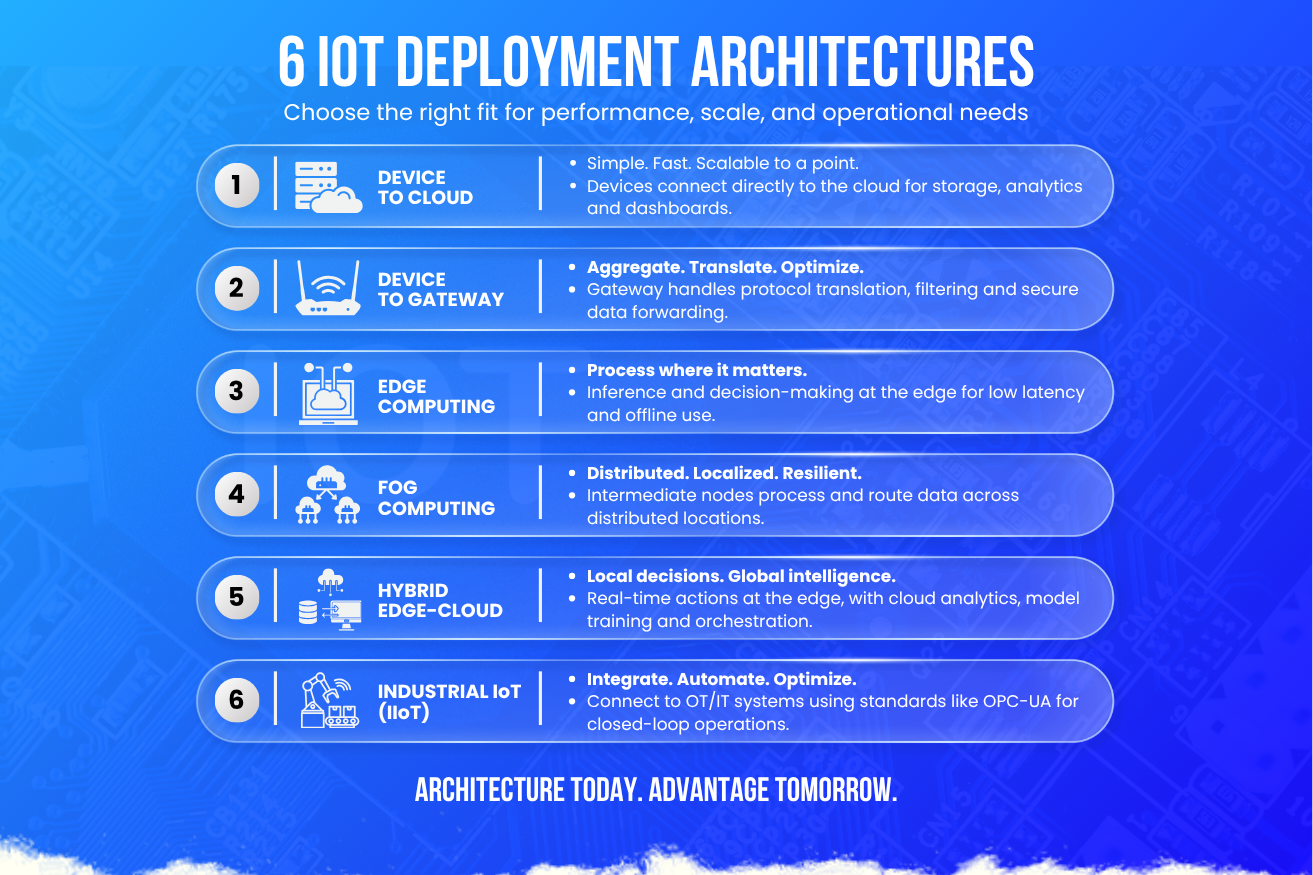
In this article, we’ll explore six major IoT deployment architectures, where each one fits best, and how organizations can choose the right model for scalability, resilience, and long-term operational success.
Why IoT Deployment Architecture Matters
IoT architecture determines:
- where data gets processed
- where decisions happen
- how devices communicate
- how systems scale
- how secure and resilient the platform becomes
The wrong architecture creates:
- latency issues
- expensive cloud bills
- unreliable field performance
- difficult firmware management
- security gaps
- costly infrastructure rewrites
The right architecture creates:
- scalable systems
- efficient operations
- reliable offline behavior
- lower operational cost
- future-ready AIoT infrastructure
What Is an IoT Deployment Architecture?
An IoT deployment architecture defines how:
- devices
- gateways
- edge systems
- cloud infrastructure
- enterprise platforms
work together to process, transmit, and act on operational data.
Different deployment models solve different engineering problems.
No single architecture is universally correct.
The best choice depends on:
- latency requirements
- connectivity quality
- fleet size
- regulatory constraints
- operational environment
- AI workload requirements
1. Device-to-Cloud Architecture
In a Device-to-Cloud model, IoT devices communicate directly with cloud infrastructure.
How Device-to-Cloud Works
Devices connect directly to platforms such as:
- AWS IoT Core
- Azure IoT Hub
- Google Cloud
- custom cloud backends
Data flows directly into the cloud for:
- storage
- analytics
- dashboards
- alerts
- automation
Advantages
Faster Deployment
Simple architecture reduces initial complexity.
Lower Hardware Requirements
No gateway infrastructure required.
Easy Centralized Management
Cloud platforms simplify orchestration and monitoring.
Limitations
Higher Latency
All operational decisions depend on network round-trips.
Cloud Dependency
Connectivity loss can impact functionality.
Scaling Cost
Bandwidth and cloud infrastructure costs rise quickly with fleet growth.
Best Use Cases
- smart home devices
- consumer IoT products
- lightweight industrial pilots
- early-stage connected systems
2. Device-to-Gateway Architecture
This model introduces a local gateway between devices and cloud infrastructure.
How Device-to-Gateway Works
Devices communicate locally using:
- BLE
- Zigbee
- LoRa
- Modbus
- CAN
- MQTT
The gateway:
- aggregates data
- translates protocols
- filters telemetry
- forwards selected data to the cloud
Advantages
Mixed Protocol Support
Ideal for heterogeneous device environments.
Lower Device Complexity
Resource-constrained devices avoid direct cloud communication.
Reduced Bandwidth Usage
Gateways optimize upstream traffic.
Challenges
Gateway Becomes Critical Infrastructure
Failure at the gateway can isolate multiple devices.
Additional Hardware Complexity
Requires deployment and management of gateway systems.
Best Use Cases
- industrial environments
- building automation
- smart factories
- legacy integration systems
3. Edge Computing Architecture
Edge computing moves intelligence closer to the operational environment.
How Edge Computing Works
AI inference and processing happen:
- on devices
- on nearby edge servers
- on industrial gateways
instead of relying entirely on centralized cloud infrastructure.
Advantages
Low Latency
Critical for real-time decision-making.
Offline Operation
Systems continue functioning without internet access.
Better Data Privacy
Sensitive information remains local.
Reduced Cloud Dependency
Only important data is transmitted upstream.
Common Edge Technologies
- NVIDIA Jetson
- AWS Greengrass
- Azure IoT Edge
- TensorFlow Lite
- ONNX Runtime
Best Use Cases
- Edge AI systems
- industrial automation
- robotics
- predictive maintenance
- autonomous infrastructure
4. Fog Computing Architecture
Fog computing distributes processing across multiple intermediate regional nodes.
How Fog Computing Works
Instead of relying on:
- a single cloud
- or a single edge device
multiple localized compute nodes process data closer to operational environments.
Advantages
Distributed Processing
Reduces centralized bottlenecks.
Better Regional Responsiveness
Localized systems react faster.
Improved Scalability
Processing load spreads across distributed infrastructure.
Challenges
Operational Complexity
Distributed orchestration becomes harder to manage.
Infrastructure Overhead
More nodes require monitoring and maintenance.
Best Use Cases
- smart cities
- oil and gas infrastructure
- utility networks
- large retail environments
5. Hybrid Edge-Cloud Architecture
Most production-grade AIoT systems eventually evolve toward hybrid architectures.
How Hybrid Architectures Work
Edge Handles:
- real-time decisions
- local automation
- low-latency inference
Cloud Handles:
- AI training
- fleet analytics
- orchestration
- OTA coordination
- long-term optimization
Advantages
Best Balance Between Speed and Scale
Combines edge responsiveness with cloud intelligence.
Better Resilience
Systems continue operating during connectivity loss.
Scalable AI Lifecycle
Cloud systems continuously improve edge intelligence.
Challenges
Increased Architectural Complexity
Requires:
- synchronization pipelines
- OTA infrastructure
- distributed monitoring
Best Use Cases
- AIoT systems
- smart manufacturing
- autonomous operations
- industrial Edge AI platforms
6. Industrial IoT Architecture
Industrial IoT architectures integrate operational technology with enterprise systems.
How IIoT Works
Devices integrate with:
- MES
- SCADA
- ERP
- PLC infrastructure
using industrial standards such as:
- OPC-UA
- PROFINET
- EtherCAT
- Modbus
Advantages
Closed-Loop Automation
Operational systems can respond automatically to telemetry.
Real-Time Operational Visibility
Improves manufacturing and industrial efficiency.
Predictive Maintenance
Reduces downtime and equipment failure.
Challenges
Strict Reliability Requirements
Downtime impacts operations directly.
Security and Governance Complexity
Industrial systems require stronger controls and segmentation.
Legacy System Integration
Older infrastructure may require custom interoperability layers.
Best Use Cases
- manufacturing systems
- industrial automation
- smart factories
- energy infrastructure
- utility operations
How to Choose the Right IoT Deployment Architecture
The best architecture depends on operational realities — not trends.
Organizations should evaluate:
1. Latency Requirements
Real-time systems often require:
- edge computing
- local processing
- event-driven architectures
2. Connectivity Reliability
Environments with unstable internet access benefit from:
- edge intelligence
- offline-first systems
- gateway-based architectures
3. Fleet Scale
Large fleets introduce:
- cloud scaling costs
- OTA management complexity
- monitoring overhead
4. Compliance Requirements
Regulated industries may require:
- localized processing
- regional data storage
- stricter governance controls
5. Total Cost of Ownership
Architecture decisions affect:
- infrastructure cost
- cloud spend
- hardware requirements
- operational maintenance
Why Hybrid AIoT Architectures Are Becoming Standard
Modern AIoT systems increasingly rely on hybrid architectures because they balance:
- low-latency edge intelligence
- scalable cloud analytics
- resilient offline operation
- centralized optimization
- continuous AI improvement
This creates systems that are:
- faster
- more scalable
- more resilient
- more adaptive
Best Practices for Building Scalable IoT Systems
Organizations building connected products should:
Design for Production Early
Architect for:
- scalability
- security
- OTA updates
- offline reliability
from the beginning.
Prioritize Event-Driven Systems
Real-time responsiveness is critical for modern AIoT.
Move Intelligence Closer to the Edge
Reduce unnecessary cloud dependency.
Secure Every Layer
Protect:
- devices
- gateways
- APIs
- cloud infrastructure
- OTA pipelines
Build Around Operational Reality
The best architecture is not the most modern one.
It is the one that survives the real deployment environment.
Conclusion
Most IoT systems do not fail because of sensors or firmware.
They fail because the deployment architecture could not support:
- operational scale
- latency constraints
- offline requirements
- security expectations
- long-term growth
Every deployment architecture represents a different decision about:
- where intelligence lives
- where data gets processed
- how systems scale
- how infrastructure evolves
The strongest IoT and AIoT systems are designed intentionally around:
- operational conditions
- scalability goals
- real-world reliability
- long-term maintainability
Architecture is not just an infrastructure choice.
It is the foundation of the entire connected product lifecycle.
About MetaDesk Global
MetaDesk Global specializes in:
- IoT and AIoT architecture
- embedded firmware development
- Edge AI systems
- PCB design
- industrial automation
- scalable connected-product engineering
We help organizations build production-ready intelligent systems designed for reliability, scalability, and long-term operational success.