




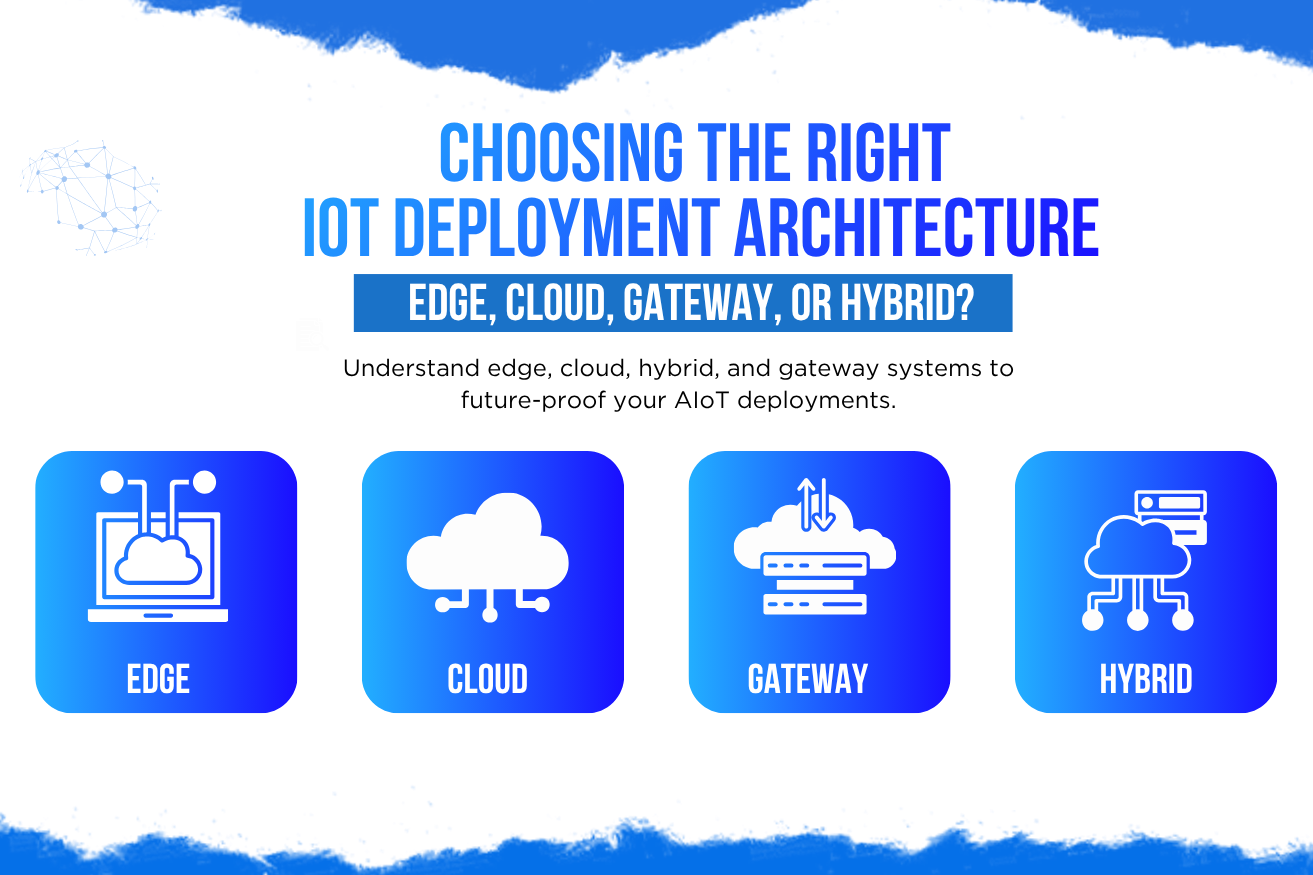
Choosing an IoT deployment architecture is usually presented as a menu: device-to-cloud, gateway, edge, fog, hybrid. Pick the one that fits. In practice teams do not struggle because they lack the menu — they struggle because nothing in the menu tells them which constraint should decide.
Architecture in connected products is not a preference. It is the output of six measurable constraints, and once those numbers exist the choice is usually obvious. Getting them wrong is expensive in a specific way: unlike most software decisions, this one is very hard to reverse after devices are in the field.
This is a decision framework rather than a catalogue. It walks through the six constraints that actually determine the answer, how to turn each into a number, and what to do when they conflict.
The Decision You Cannot Easily Undo
Most architectural mistakes in software are recoverable. You refactor, you migrate, you ship. Connected products are different because the decision is embedded in hardware that is already installed somewhere you cannot reach.
- Compute capability is fixed at the point the board is designed — you cannot add a processor to a deployed fleet
- Power budget is fixed by the battery and enclosure
- Radio choice determines bandwidth, range, and recurring cost for the product’s entire life
- Gateway presence or absence changes the physical installation at every site
The practical consequence is that the architecture must be chosen against the requirements the product will have in three years, not the ones the prototype has today. That is why the constraints below are worth taking seriously before the first PCB is laid out.
Six Constraints That Decide the Architecture
Work through these in order. Each one either eliminates options or forces a specific structure, and by the end the viable set is normally down to one or two.
Decision latency — how fast must the system react?
Not how fast data reaches a dashboard. How long may pass between a physical event and the system responding to it.
- Under 10 ms — the decision must happen on the device. No network is involved.
- 10–500 ms — device or a local edge node. A round trip to a regional cloud is already marginal.
- Seconds — cloud is viable if connectivity is dependable.
- Minutes or longer — latency is not a constraint; decide on other grounds.
Be honest here. Teams routinely specify sub-second requirements for processes where an operator responds in ten minutes, and that inflated number pushes them into an unnecessarily complex and expensive architecture.
Connectivity reality — what is the link actually like?
Describe the worst realistic case, not the typical one: available bandwidth, expected outage duration, and whether outages are minutes, hours, or days.
If the system must keep functioning through an outage, local compute is mandatory and the question becomes where it sits. If it may pause, cloud dependence is acceptable. Either way, buffering with ordered, deduplicated replay is required — the offline-first pattern is a baseline expectation in field deployments, not a premium feature.
Data volume and the cost of moving it
Compute the raw generation rate per device, multiply by fleet size, and price it against your connectivity and ingestion tariff over a year. Then ask what fraction of that data anyone will ever look at.
When the answer is a small fraction — which it almost always is for high-rate sensing — processing at the source stops being an optimisation and becomes the only affordable design. This is where data reduction at the edge earns its place in the architecture.
Power budget — what can the device afford to do?
Mains-powered devices can compute and transmit freely. Battery devices cannot, and the ranking is consistent: transmitting costs far more than computing, and computing costs far more than sensing.
For a device that must run for years on a cell, this single constraint usually settles the design: sense continuously, decide locally, transmit rarely and briefly. Any architecture requiring frequent cloud round trips is eliminated regardless of its other merits.
Security and data governance
Some constraints are non-negotiable and set by someone other than the engineering team: data residency rules, a prohibition on raw video or personal data leaving a site, an industrial security policy that forbids inbound connections, or a requirement for deterministic and explainable behaviour.
These eliminate options outright rather than trading off against others, so identify them early. Discovering a residency requirement after the platform is built is a rebuild, not a configuration change.
Fleet scale and operational reach
How many devices, across how many sites, and who can physically touch them? A hundred devices in one building tolerates architectures that ten thousand devices across four hundred sites will not.
Scale also determines whether a gateway helps or hurts. Gateways concentrate complexity into one manageable place per site — excellent when there are many devices per site, unhelpful when devices are geographically scattered and each would need its own.
From Constraints to an Architecture
With the six answers written down, the mapping is fairly mechanical.
| Dominant constraint | Architecture it implies | Typical fit |
|---|---|---|
| Low volume, tolerant latency, good connectivity | Device-to-cloud | Utility metering, environmental sensing, asset tracking |
| Many devices per site, constrained radios | Device-to-gateway | Building systems, retail, agriculture, healthcare facilities |
| Hard real-time or must survive outages | Edge computing | Machine control, safety interlocks, autonomous equipment |
| High-rate data, expensive to transport | Edge pre-processing with cloud aggregation | Vision inspection, vibration monitoring, audio analytics |
| Local reaction plus fleet-wide learning | Hybrid edge–cloud | Predictive maintenance, energy optimisation, multi-site operations |
| Strict residency or no outbound raw data | On-premise or private edge | Regulated industry, defence, sensitive process data |
Most production systems end up hybrid, and that is a healthy outcome rather than indecision. The useful discipline is not picking one tier but assigning each responsibility to exactly one: the device decides what happened, the edge decides what it means locally, the cloud decides what it means across the fleet over time.
An architecture is not a diagram of components. It is a statement about where each decision is allowed to be made.
Five Mistakes That Show Up Later
Designing for the Architecture You Will Need Next
Requirements move in a predictable direction. Fleets grow, data rates rise, and someone eventually asks for a prediction rather than a chart. You do not need to build for that on day one, but you should avoid foreclosing it.
Frequently Asked Questions
Conclusion
There is no best IoT deployment architecture, and comparison tables alone will not produce an answer. The decision falls out of six constraints — latency, connectivity, data volume, power, governance, and scale — once each has been given an honest number rather than an aspirational one.
Do that work before the hardware is fixed, assign every decision to exactly one tier, and leave enough headroom to evolve. The result is a system that grows with the product rather than one the product eventually has to escape.