




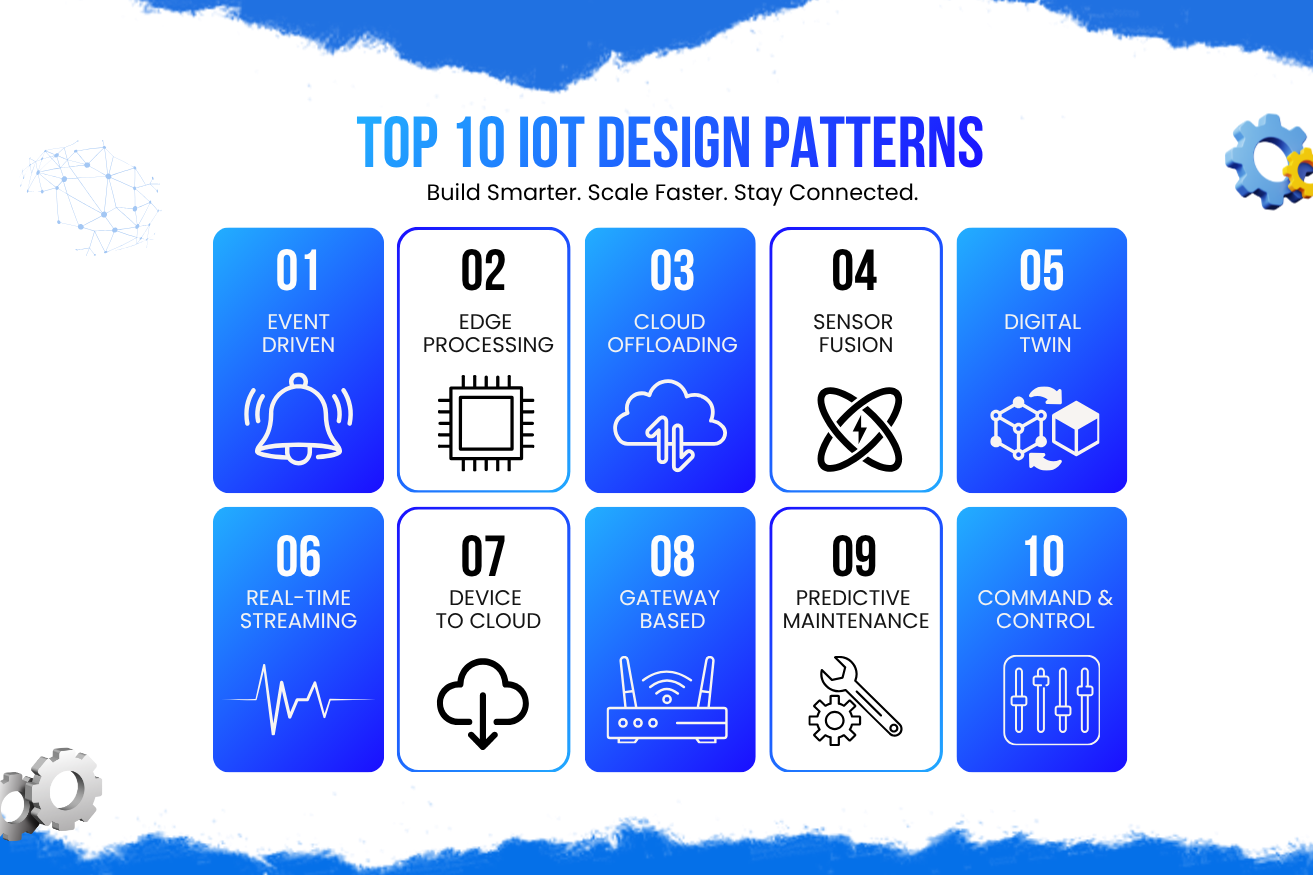
Building an IoT product is not only about connecting sensors to the cloud. The real challenge begins when systems need to:
- Scale across thousands of devices
- Process real-time data
- Support AI-driven automation
- Operate reliably offline
- Integrate with enterprise systems
- Remain secure and maintainable over time
At MetaDesk Global, we’ve seen that the most successful IoT and AIoT platforms are built around proven architectural design patterns — reusable solutions that reduce complexity, improve scalability, simplify maintenance, and optimize performance. This article explores the most important IoT system design patterns used in modern embedded systems, AIoT platforms, industrial automation, and Edge AI deployments.
Why IoT Design Patterns Matter
As IoT systems grow, complexity increases rapidly. A small pilot may work with simple device communication, direct cloud connectivity, and basic dashboards. But production systems require distributed intelligence, event-driven workflows, edge processing, resilient infrastructure, and scalable data pipelines.
Without strong architectural patterns, systems become difficult to maintain, expensive to scale, and unreliable under real-world conditions. Design patterns provide reusable architectural solutions for common IoT engineering challenges — the same discipline that underpins the core components of an IoT system.
What Are IoT System Design Patterns?
IoT design patterns are proven architectural approaches used to solve recurring challenges in connected systems. They define how devices communicate, where data gets processed, how systems scale, how automation works, and how intelligence is distributed. Modern AIoT systems often combine multiple patterns together depending on operational requirements.
The 10 Essential IoT System Design Patterns
Event-Driven Architecture Pattern
Event-driven systems react instantly to changes in device state or operational conditions. Devices emit events — sensor threshold breaches, machine anomalies, motion detection, environmental changes — that trigger automated workflows in real time.
- Real-time responsiveness — systems react immediately without waiting for scheduled processing
- Scalable automation — workflows become modular and distributed
- Reduced operational delays — critical actions happen faster
- MQTT, Apache Kafka, RabbitMQ, AWS IoT Events, Azure Event Hub
- Industrial automation, smart buildings, predictive maintenance, alarm systems, AIoT workflows
Edge Processing Pattern
Edge computing moves processing closer to devices. Instead of sending all telemetry to the cloud, devices or local gateways process data locally — reducing latency, bandwidth usage, and cloud dependency.
- Low latency — critical for real-time systems
- Offline operation — systems keep working without internet connectivity
- Improved privacy — sensitive data remains local
- NVIDIA Jetson, Raspberry Pi, AWS Greengrass, Azure IoT Edge, ONNX Runtime
These benefits come with real trade-offs — see our guide to Edge AI deployment challenges. Best for edge AI, computer vision, industrial robotics, autonomous systems, and remote monitoring.
Cloud Offloading Pattern
Cloud offloading moves heavy workloads to centralized infrastructure. Devices collect and transmit data while cloud systems handle large-scale analytics, machine learning training, long-term storage, and fleet management.
- High scalability — cloud handles large device fleets efficiently
- Centralized intelligence — global insights improve operational visibility
- Reduced device complexity — embedded hardware stays simpler
- Increased latency from cloud round-trips; connectivity dependency during outages
Best for enterprise analytics, AI model training, fleet optimization, and historical reporting.
Sensor Fusion Pattern
Sensor fusion combines data from multiple sensors — GPS, IMU, cameras, temperature, pressure, LiDAR, accelerometers — to create richer operational context.
- Improved accuracy — multiple data sources reduce errors
- Better reliability — systems tolerate individual sensor failures
- Context-aware intelligence — more complete environmental understanding
Best for autonomous systems, smart vehicles, robotics, industrial monitoring, and AIoT systems.
Digital Twin Pattern
Digital twins create virtual representations of physical assets. Real-world device data continuously updates a virtual model of machines, infrastructure, environments, or production systems.
- Predictive simulation — test operational scenarios safely
- Performance optimization — continuously improve efficiency
- Better monitoring — understand asset behavior in real time
Best for manufacturing, industrial automation, smart cities, predictive maintenance, and infrastructure management.
Real-Time Streaming Pattern
Streaming systems continuously process live telemetry. Instead of storing data first, systems analyze live streams immediately — enabling instant dashboards, operational alerts, and live analytics.
- Immediate insights — no batch-processing delay
- Faster decision-making — supports operational automation
- Continuous visibility — live monitoring improves responsiveness
- Apache Kafka, Apache Flink, Spark Streaming, AWS Kinesis
Best for industrial telemetry, financial systems, AIoT analytics, and operational monitoring.
Device-to-Cloud Pattern
In this architecture, devices communicate directly with cloud infrastructure — a simple, low-cost approach ideal for small systems.
- Simpler architecture — easy to deploy for small systems
- Lower initial cost — no gateway infrastructure required
- Centralized management — cloud platforms simplify orchestration
- Latency makes real-time responsiveness difficult; cloud traffic costs increase rapidly at scale
Best for consumer IoT, smart home products, and lightweight deployments.
Gateway-Based Architecture Pattern
Gateways act as intermediaries between devices and cloud systems — aggregating device data, translating protocols, managing security, and optimizing bandwidth usage.
- Supports mixed protocols — useful in industrial and legacy environments
- Better local processing — gateways can perform edge analytics
- Reduced cloud traffic — only important data moves upstream
Best for Industrial IoT, building automation, smart factories, and mixed device ecosystems. This choice sits at the heart of your IoT deployment architecture.
Predictive Maintenance Pattern
Predictive maintenance systems forecast failures before breakdowns occur. AI and analytics process vibration data, thermal patterns, operational telemetry, and machine behavior to detect early signs of failure.
- Reduced downtime — maintenance happens proactively
- Lower operational cost — avoid unnecessary servicing
- Improved equipment reliability — assets remain operational longer
Best for manufacturing, energy systems, industrial equipment, and fleet operations. Explore this in depth in our guide to predictive maintenance in IoT.
Command and Control Pattern
This pattern enables centralized operational control across device fleets. Cloud or operational systems issue commands — firmware updates, remote automation, operational adjustments — to edge devices, industrial machines, and smart infrastructure.
- Centralized orchestration — large fleets become manageable
- Remote automation — systems respond without physical intervention
- Better operational efficiency — reduces manual processes
Best for industrial automation, smart grids, building control systems, and AIoT infrastructure.
Why Modern AIoT Systems Combine Multiple Patterns
Most production-grade systems do not rely on a single design pattern. Modern AIoT architectures combine edge intelligence, cloud analytics, event-driven systems, streaming pipelines, OTA infrastructure, and digital twin systems. The goal is balancing latency, scalability, reliability, security, and operational complexity — and tracking it all with the right IoT platform KPIs.
How to Choose the Right IoT Design Pattern
Choosing the right architecture depends on your deployment environment, connectivity conditions, latency requirements, device constraints, operational scale, and security needs. The strongest IoT systems are not the most complex — they are the systems designed intentionally around real-world constraints.
Best Practices for Building Scalable IoT Architectures
Frequently Asked Questions
Conclusion
IoT systems do not scale accidentally. They scale through deliberate architectural design patterns that support distributed intelligence, real-time responsiveness, operational reliability, and scalable automation.
The right design pattern depends on your environment, operational goals, latency requirements, infrastructure constraints, and long-term scalability plans. Successful IoT and AIoT platforms are built layer by layer — with architecture decisions that support real-world production environments from day one.