


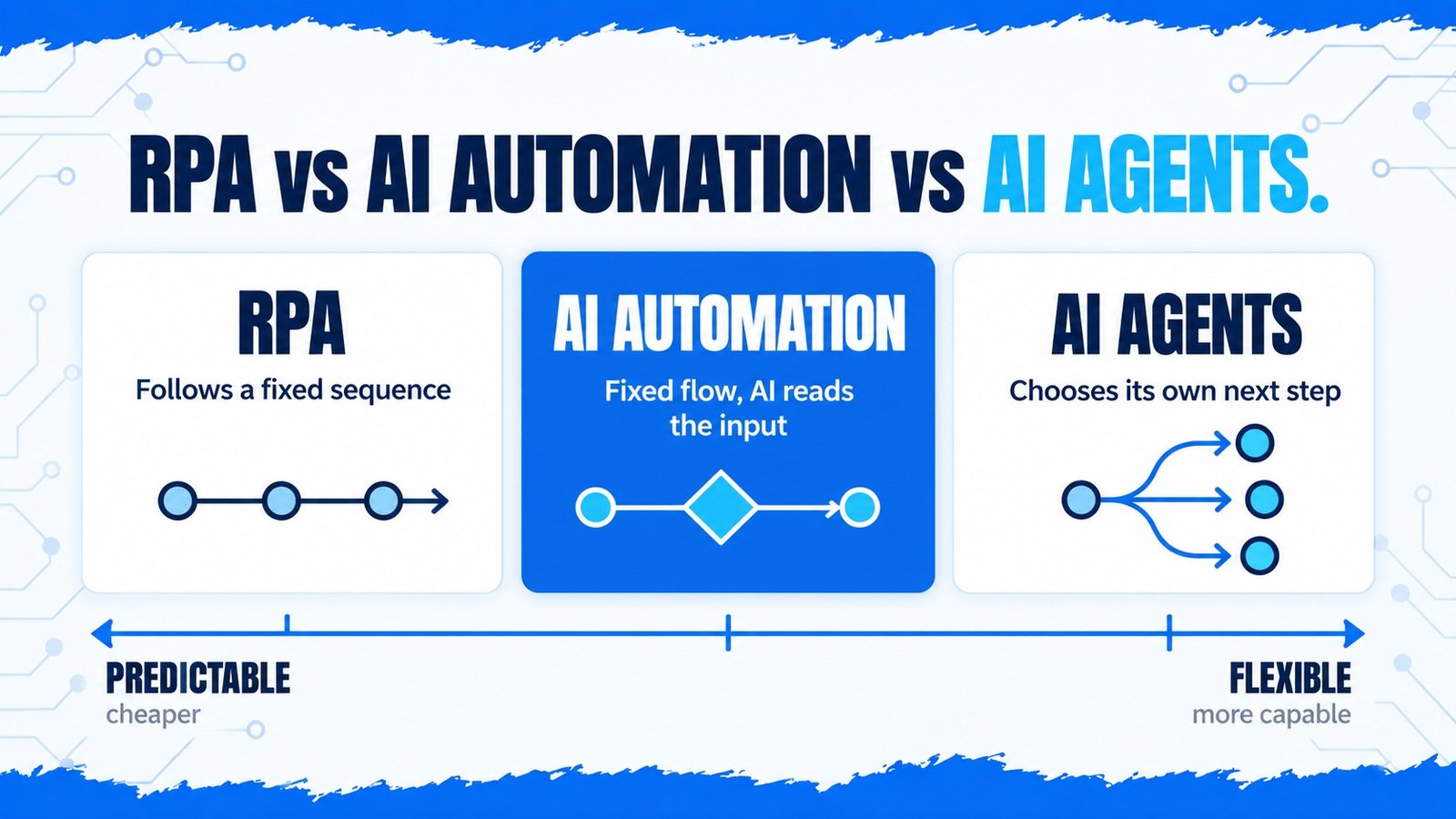
Three terms get used interchangeably in automation conversations, and they describe genuinely different things: RPA follows fixed rules, AI automation handles variable input, and AI agents decide their own next step. Choosing the wrong one is expensive — either you pay for intelligence a rule could have provided, or you deploy a rule where judgement was required and it breaks on the first unusual case.
This guide defines each properly, shows where each belongs, and gives a simple test for deciding which your process actually needs.
What Each One Actually Is
RPA — robotic process automation
Software that performs a fixed sequence of steps, often by driving the user interface of existing applications: open this screen, copy that field, paste it there, click submit.
It is deterministic and auditable. It is also brittle — it does exactly what it was told, so a changed screen layout or an unexpected field breaks it. RPA excels at stable, structured, high-volume tasks where the input is consistent.
AI automation — rules plus understanding
A defined workflow where one or more steps use AI to handle something a rule cannot: reading an invoice whose layout differs by supplier, classifying the intent of an email, extracting fields from free text, summarising a document.
The flow itself is still fixed and predictable. The intelligence is applied at specific points, which keeps the system explainable while extending it into the large share of work that involves unstructured input.
AI agents — systems that choose their own steps
Rather than following a predetermined path, an agent is given a goal and a set of tools, and decides what to do next based on what it finds: look up the customer, check the order, consult the policy, draft a response, escalate if unclear.
This flexibility is genuinely useful for tasks where the path cannot be known in advance. It also changes the failure mode: instead of one wrong output, you can get a wrong sequence of individually reasonable actions, which is why agents need bounded authority and logged reasoning.
Side by Side
| RPA | AI automation | AI agents | |
|---|---|---|---|
| Decides the path | Developer, in advance | Developer, in advance | The system, at runtime |
| Handles unstructured input | No | Yes | Yes |
| Predictability | Total | High | Variable |
| Explainability | Trivial | Good | Requires deliberate logging |
| Breaks when | The interface or format changes | Input drifts far from expectations | It reasons its way somewhere unintended |
| Cost to build | Low | Moderate | High |
| Running cost | Low | Per-use model cost | Higher — multiple model calls per task |
| Governance needed | Minimal | Confidence thresholds, escalation | Bounded authority, audit trail, rollback |
| Best for | Stable, structured, repetitive tasks | Documents, language, classification | Investigation and multi-step coordination |
Flexibility is not free. Every step up this ladder buys capability and pays for it in predictability.
A Three-Question Test
Is the input always in the same shape?
If yes — a fixed CSV, a consistent form, the same screen every time — use RPA or plain workflow automation. Adding AI here spends money and introduces variability for nothing.
Is the sequence of steps always the same?
If the input varies but the process does not — every invoice looks different, but every invoice is read, validated and posted the same way — use AI automation. A fixed flow with AI at the understanding steps gives you capability while keeping the system predictable.
This covers the majority of real business automation, and it is where most organisations should start.
Does the path genuinely depend on what is found along the way?
Only then do you need an agent. Investigating a support issue, triaging an incident, or reconciling a discrepancy where each finding determines the next lookup — these cannot be expressed as a fixed flow.
If you cannot describe why a fixed flow would fail, you probably do not need an agent yet. Reaching for one too early is a recurring theme in why AI automation projects fail.
Most Real Systems Use All Three
These are layers rather than competitors. A realistic order-processing system might look like this:
- AI automation reads the incoming PDF order and extracts line items, quantities and references
- Deterministic rules validate against the price list, stock levels and credit limit — because these must be exact and auditable
- RPA or an API call creates the order record in the ERP
- An agent handles only the exceptions: an unrecognised product code, a quantity that looks wrong, a customer on hold — investigating and proposing a resolution for a human to approve
Note where the agent sits. It handles the small share of cases that genuinely need judgement, while the high-volume path stays predictable and cheap. Building the entire flow as an agent would be slower, more expensive and far harder to audit.
Choosing Well
For a view of where these fit in a delivery plan and what each costs to build, see our AI automation services and the breakdown of AI automation costs.
Frequently Asked Questions
Conclusion
RPA, AI automation and AI agents are three points on a scale that trades predictability for flexibility. Rules are cheap and brittle, AI automation handles messy input while staying explainable, and agents handle genuine uncertainty at the cost of predictability and running cost.
Ask the three questions — is the input consistent, is the sequence fixed, does the path depend on what is found — and choose the simplest option that passes. In most businesses that answer is AI automation for the main flow, deterministic rules for anything exact, and an agent reserved for the exceptions.