Artificial Intelligence of Things (AIoT) is transforming how connected systems operate — enabling devices to not only collect data, but also make decisions, automate actions, and continuously improve.
Yet despite the promise, a large number of AIoT projects fail before reaching full-scale deployment.
Surprisingly, the issue is not weak AI models.
👉 The real problem is that most systems are designed for visibility, not intelligence.
This article explores why AIoT systems fail — and how organizations can design architectures that evolve from simple monitoring tools into autonomous, production-grade systems.
What is AIoT and Why It Matters
AIoT combines IoT infrastructure with artificial intelligence to create systems that can:
- Analyze real-time data
- Predict outcomes
- Trigger automated actions
- Learn and improve over time
Unlike traditional IoT systems that focus on dashboards and alerts, AIoT systems are designed to act independently and optimize continuously.
The Core Problem: Designing for Visibility Instead of Intelligence
Most IoT systems start with:
- Sensor integration
- Connectivity pipelines
- Data visualization dashboards
This creates a sense of progress — teams can see real-time data flowing.
However, these systems often stop there.
They lack:
- Decision-making capabilities
- Automated workflows
- Continuous learning mechanisms
As a result, organizations end up with expensive monitoring systems instead of intelligent platforms.
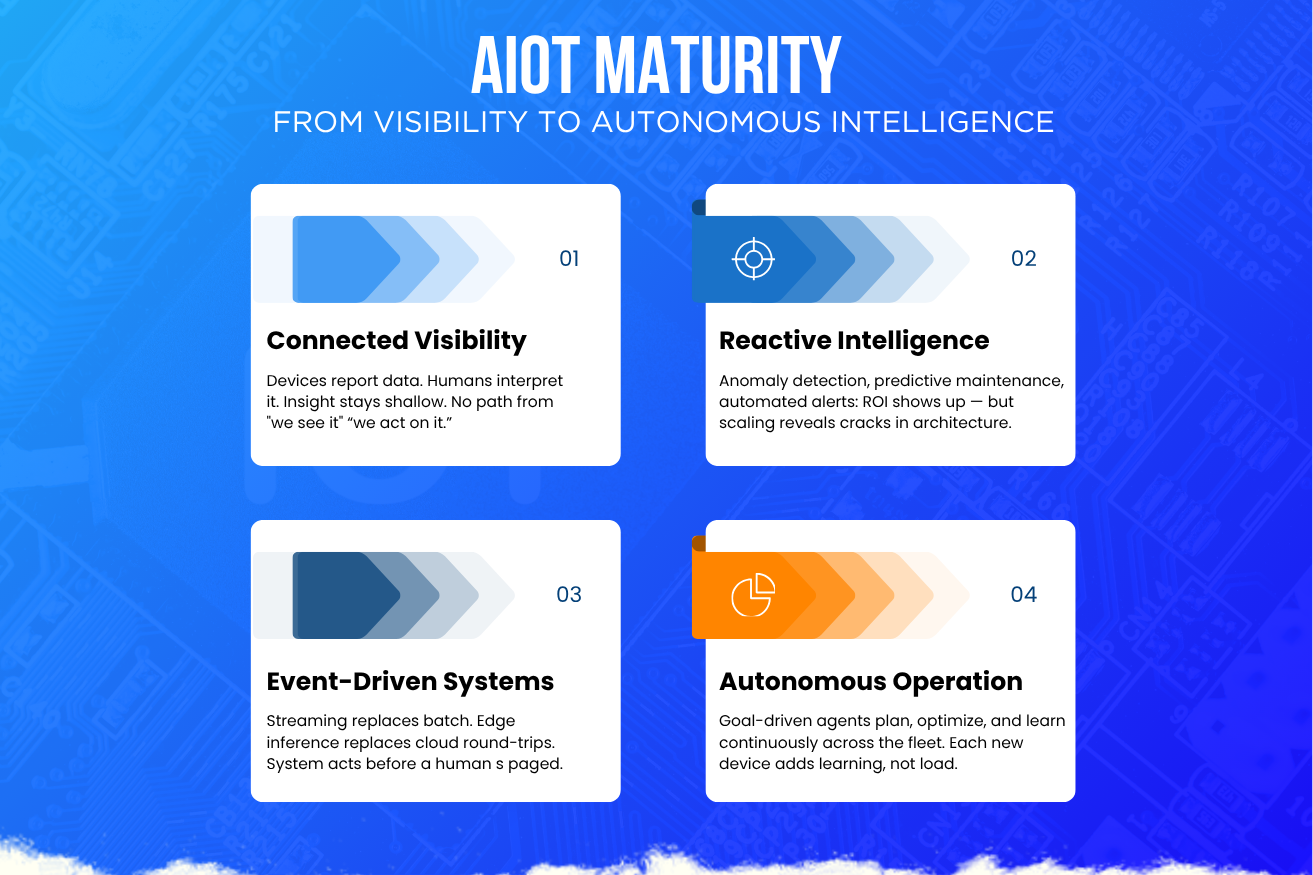
The AIoT Maturity Model: From Data to Autonomy
Building a successful AIoT system requires understanding how systems evolve over time.
Stage 1: Connected Visibility
At this stage, systems focus on:
- Device connectivity
- Data collection
- Dashboard visualization
Humans are responsible for interpreting data and making decisions.
Characteristics:
- Basic telemetry
- Manual intervention
- Limited insights
Common Tools:
MQTT, AWS IoT Core, Azure IoT Hub, Grafana
Stage 2: Reactive Intelligence
The system introduces:
- Anomaly detection
- Predictive maintenance
- Automated alerts
This is where organizations begin to see measurable ROI.
Challenges:
- Cloud latency
- Scaling limitations
- Fragmented data pipelines
- Manual model retraining
Common Tools:
AWS SageMaker, Databricks, InfluxDB, Kafka
Stage 3: Event-Driven Systems
Systems shift to real-time processing and distributed intelligence.
Key Capabilities:
- Event-driven architecture
- Streaming data pipelines
- Edge-based inference
- Closed-loop automation
At this stage, systems begin making decisions before human intervention is required.
Common Tools:
Kafka, Apache Flink, AWS Greengrass, NVIDIA Jetson, ONNX Runtime
Stage 4: Autonomous Operation
This is the final stage of AIoT maturity.
Systems:
- Optimize operations continuously
- Learn from fleet-wide data
- Adapt to changing conditions
- Reduce dependency on centralized control
Key Outcomes:
- Predictable scalability
- Reduced operational costs
- High system reliability
- Self-improving intelligence
The Role of Resilience in AIoT Systems
One of the most overlooked aspects of AIoT design is system resilience.
In real-world environments, failure is inevitable.
AIoT systems must be designed with:
- Fail-safe mechanisms
- Redundancy strategies
- Human override capabilities
- Continuous health monitoring
Unlike traditional software systems, AIoT failures can result in:
- Operational downtime
- Safety risks
- Financial losses
Resilience is not optional — it is foundational.
Key Design Principles for Scalable AIoT Systems
To successfully move from pilot to production, organizations should focus on:
- Build for Real-Time Intelligence
Adopt event-driven architectures instead of batch processing. - Distribute Intelligence Across Edge and Cloud
Use edge computing for low-latency decisions and cloud platforms for large-scale analytics. - Implement Continuous Feedback Loops
Ensure systems learn from real-world outcomes and improve over time. - Design for Scalability from Day One
Avoid ad-hoc pipelines that break under increased device load. - Prioritize Reliability and Fault Tolerance
Ensure systems continue operating even under failure conditions.
Why Most AIoT Systems Fail to Scale
Even well-designed prototypes can fail when scaled due to:
- High latency from cloud-only architectures
- Inefficient data pipelines
- Lack of model lifecycle management
- Poor integration between system layers
- Absence of automated decision-making
Scaling AIoT requires holistic system design, not just better models.
From Monitoring Systems to Autonomous Platforms
The transition from IoT to AIoT is not just a technological upgrade — it is a shift in mindset.
| Traditional IoT | AIoT Systems |
|---|
| Data collection | Intelligent decision-making |
| Dashboards | Autonomous actions |
| Alerts | Self-correcting workflows |
| Manual analysis | Continuous learning |
Organizations that embrace this shift build systems that:
- Reduce human dependency
- Improve operational efficiency
- Scale intelligently over time
Conclusion: Build Systems That Keep Running
The most successful AIoT systems are not necessarily the most advanced.
They are the ones that:
- Operate reliably in real-world conditions
- Adapt to changing environments
- Continue functioning under failure
- Improve continuously over time
👉 In AIoT, intelligence is important — but reliability is what wins in production.
About MetaDesk Global
MetaDesk Global specializes in designing and building end-to-end AIoT systems — from embedded firmware and hardware design to cloud integration and intelligent automation.
We help organizations move beyond dashboards and build production-ready autonomous systems that scale reliably in the real world.