The Internet of Things is easier to understand through examples than definitions. An IoT system is any physical thing that senses something, sends that data over a network, and uses it to inform a decision or trigger an action, sometimes automatically and sometimes through a person. By IoT Analytics’ count there were about 18.5 billion connected IoT devices in 2024, a figure expected to reach around 39 billion by 2030.
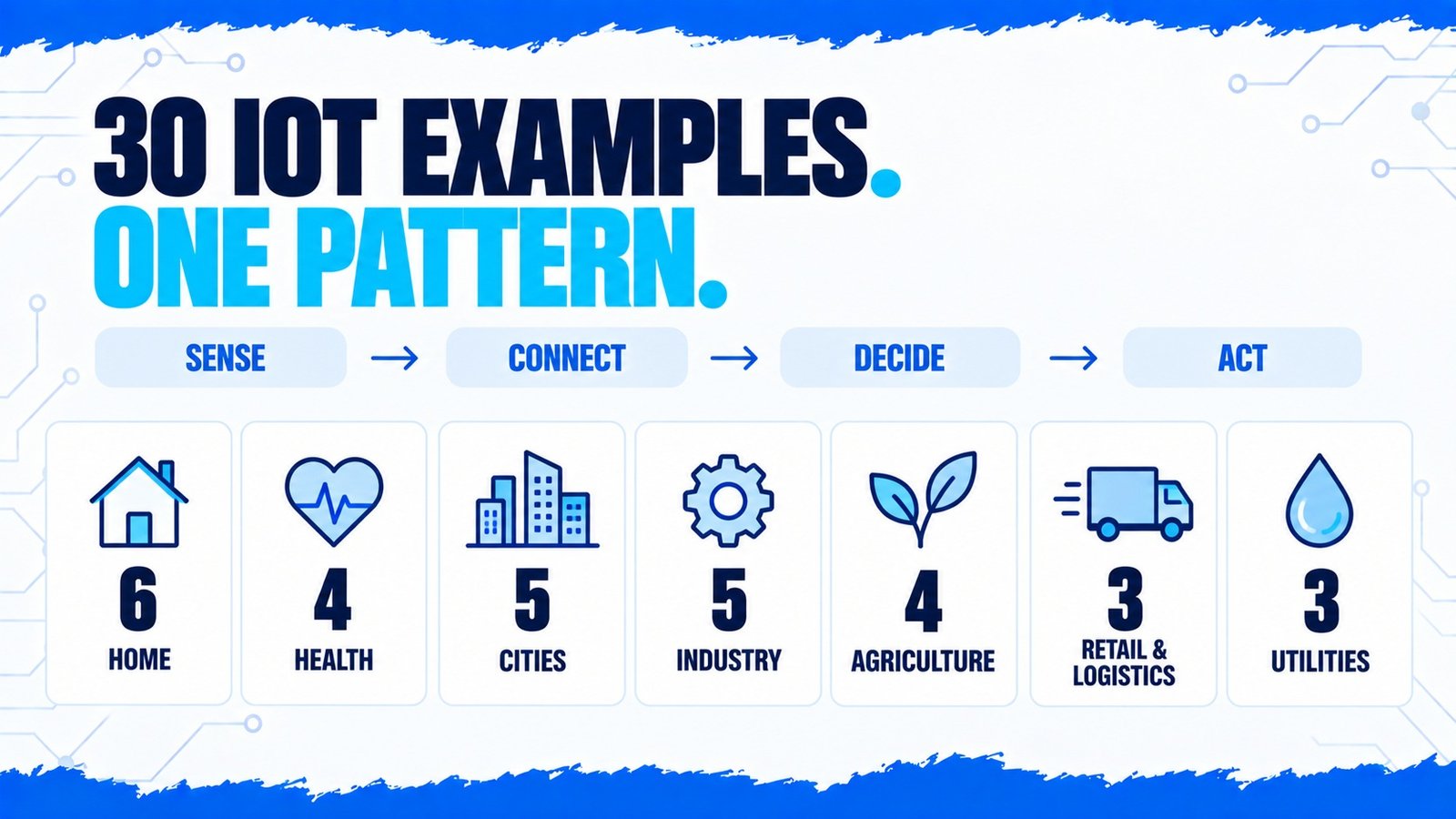
Below are 30 real-world IoT examples, grouped by where you meet them: at home, on your body, in cities, in factories, on farms, in shops and supply chains, and in utilities. For each one we note what is sensed and what actually changes because of it, which is the part that separates a useful IoT application from a gadget.
The Pattern
What Makes Something an IoT Example
Every example below follows the same loop. Knowing it makes it easy to spot IoT in places you might not expect.
| Stage | What happens | Smart thermostat example |
|---|
| Sense | A sensor measures something physical | Room temperature and occupancy |
| Connect | Data travels over a network | Wi-Fi to a cloud service |
| Decide | Software interprets the data | Learns the household’s schedule |
| Act | Something changes in the physical world | Turns heating down when the house is empty |
A smartphone is a connected device but is usually not counted as IoT, because it is a general-purpose computer used directly by a person. A fitness tracker, a smart meter or a connected pump is IoT, because it measures the world on its own and reports without anyone operating it. The engineering inside each step is explained in how IoT devices work.
Daily Life
IoT Examples in Daily Life and the Home
1. Smart thermostats
Sense temperature and occupancy, learn routines and adjust heating and cooling. The value is energy saved when nobody is home, not the app.
2. Video doorbells and security cameras
Detect motion, stream video and send alerts to a phone. Newer models run person and package detection on the device itself to cut false alarms.
3. Smart locks
Lock and unlock over Bluetooth, Wi-Fi or Thread, issue temporary codes to visitors and log every entry.
4. Smart lighting and plugs
Switch on schedules, presence or voice commands. Plugs that measure power use show which appliances quietly waste energy.
5. Water leak detectors
A cheap sensor under a sink or washing machine alerts you, or closes a smart valve, before a slow leak becomes a ruined floor.
6. Robot vacuums
Map rooms with lidar or cameras, report progress and take instructions remotely. A good example of IoT combined with on-device intelligence.
Most new smart-home devices now support Matter, a shared standard that lets products from different brands work together. What it does and does not fix is covered in the Matter protocol explained.
Health
IoT Examples in Healthcare and Wearables
7. Fitness trackers and smartwatches
Measure heart rate, movement and sleep, and increasingly flag irregular heart rhythms for a doctor to check.
8. Continuous glucose monitors
A small sensor on the skin reports glucose levels every few minutes to a phone, replacing most finger-prick tests for people with diabetes.
9. Remote patient monitoring
Connected blood-pressure cuffs, scales and pulse oximeters send readings from home so clinicians can spot deterioration early.
10. Hospital asset tracking
Tags on wheelchairs, pumps and monitors show where equipment is, so staff stop searching corridors for it.
These and other medical applications, along with the regulation they bring, are covered in detail in IoT in healthcare.
Cities
IoT Examples in Smart Cities and Transport
11. Smart parking
Sensors in each bay report whether it is occupied, guiding drivers to free spaces and cutting the traffic caused by people circling.
12. Connected street lighting
Lights dim when streets are empty, brighten for pedestrians and report their own faults instead of waiting for a complaint.
13. Adaptive traffic signals
Cameras and road sensors measure queues and adjust signal timing in real time rather than on a fixed cycle.
14. Fleet telematics
Trackers report location, fuel, engine faults and driving behaviour for buses, vans and trucks, improving routing and maintenance.
15. EV chargers and shared scooters
Chargers report availability and take payment remotely; shared bikes and scooters report location and battery so operators know where to rebalance.
Industry
IoT Examples in Industry and Manufacturing
16. Predictive maintenance
Vibration, temperature and current sensors on motors and pumps reveal wear weeks before a breakdown, so repairs are planned instead of urgent.
17. Machine monitoring
Connecting machines to a dashboard shows real uptime, cycle times and stoppages, often revealing that utilisation is far lower than assumed.
18. Asset and tool tracking
Tags on pallets, containers, tools and forklifts show where things are across a site, cutting search time and losses.
19. Energy monitoring
Sub-meters on lines and machines show where energy goes, turning a single monthly bill into something that can be managed.
20. Digital twins
Live sensor data keeps a virtual model of a machine or line in step with the real one, so changes can be tested before they are made. See
digital twin technology.
Industrial applications like these are often called IIoT, the Industrial Internet of Things; the differences are covered in IoT vs AIoT vs IIoT, and predictive maintenance in depth in predictive maintenance in IoT.
Agriculture
IoT Examples in Agriculture
21. Soil moisture and smart irrigation
Probes at several depths measure moisture so irrigation runs only where and when the crop needs it, saving water and pumping energy.
22. Livestock monitoring
Collars and ear tags track movement, rumination and temperature to flag illness or heat early. The engineering behind them is in our piece on
smart livestock monitoring.
23. Greenhouse climate control
Temperature, humidity, light and CO2 sensors drive vents, heaters and shading automatically.
24. Grain and silo monitoring
Temperature cables inside stored grain detect hot spots that signal spoilage before a whole bin is lost.
Farms are where long-range, low-power networks such as LoRaWAN shine, because sensors may be kilometres from the nearest building. The trade-offs are compared in our guide to IoT protocols.
Retail and Logistics
IoT Examples in Retail and the Supply Chain
25. Cold-chain monitoring
Temperature loggers in trucks, containers and fridges prove that food and vaccines stayed in range, and alert in time to save a load.
26. Container and parcel tracking
Cellular trackers report location, shock and door openings for high-value shipments across borders.
27. Electronic shelf labels and smart shelves
Prices update centrally in seconds, and shelf sensors or cameras flag gaps before customers find them.
Utilities
IoT Examples in Utilities and the Environment
28. Smart meters
Electricity, gas and water meters report readings automatically, ending estimated bills and helping utilities balance demand.
29. Water network leak detection
Acoustic and pressure sensors on pipes locate leaks in the network itself, where large volumes of treated water are often lost. More in
IoT and water management.
30. Air quality monitoring
Networks of low-cost sensors map pollution street by street, and indoor monitors adjust ventilation based on CO2 levels.
Lessons
What the Successful Examples Have in Common
Look across the thirty and a pattern appears. The applications that stick are not the cleverest; they are the ones where a measurement reliably changes a decision that costs money, time or safety.
2They survive the real environment
3They keep working without the cloud
When Insteon’s cloud service shut down abruptly in April 2022, many owners lost app control of their homes overnight. Good designs keep core functions local.
4They can be updated securely
Devices live for years. Without secure over-the-air updates, every vulnerability found after launch is permanent.
FAQ
Frequently Asked Questions
What are some examples of IoT in daily life?
Smart thermostats, video doorbells, smart locks, smart lighting, fitness trackers, robot vacuums and smart meters. Each senses something, connects to a network and changes something without a person operating it directly.
What are examples of IoT in industry?
Predictive maintenance sensors on machines, machine monitoring for uptime, asset and tool tracking, energy sub-metering and digital twins of production lines. Industrial uses are often called IIoT.
What are examples of IoT in agriculture?
Soil moisture sensors driving irrigation, livestock collars that detect illness, greenhouse climate control and temperature monitoring inside grain silos.
Is a smartphone an IoT device?
Usually not. A smartphone is a general-purpose computer operated by a person. It often acts as the gateway or control screen for IoT devices such as wearables and smart locks.
How many IoT devices are there?
IoT Analytics counted about 18.5 billion connected IoT devices in 2024, expected to reach around 21.1 billion by the end of 2025 and roughly 39 billion by 2030.
What is the most common IoT application?
By device count, consumer and smart-home devices and smart meters are among the largest groups. By business value, industrial applications such as predictive maintenance and asset tracking are among the most widely deployed.
Wrapping Up
Conclusion
From thermostats to grain silos, every IoT example follows the same loop: sense, connect, decide, act. The ones worth building are those where the measurement reliably changes a decision, and where the device keeps working in the real environment for years.
If one of these examples resembles a product you want to build, our guide on how to build an IoT product walks through the stages, and our embedded IoT solutions team designs the hardware, firmware and cloud behind it.